

Delhi (Gurpreet Singh) : As the global political and economic order shifts, major world powers are rapidly expanding military spending, pushing the world toward a renewed nuclear arms race. Growing rivalry over markets, resources, and strategic dominance has heightened insecurity, prompting states to view nuclear weapons as the ultimate shield for national survival.
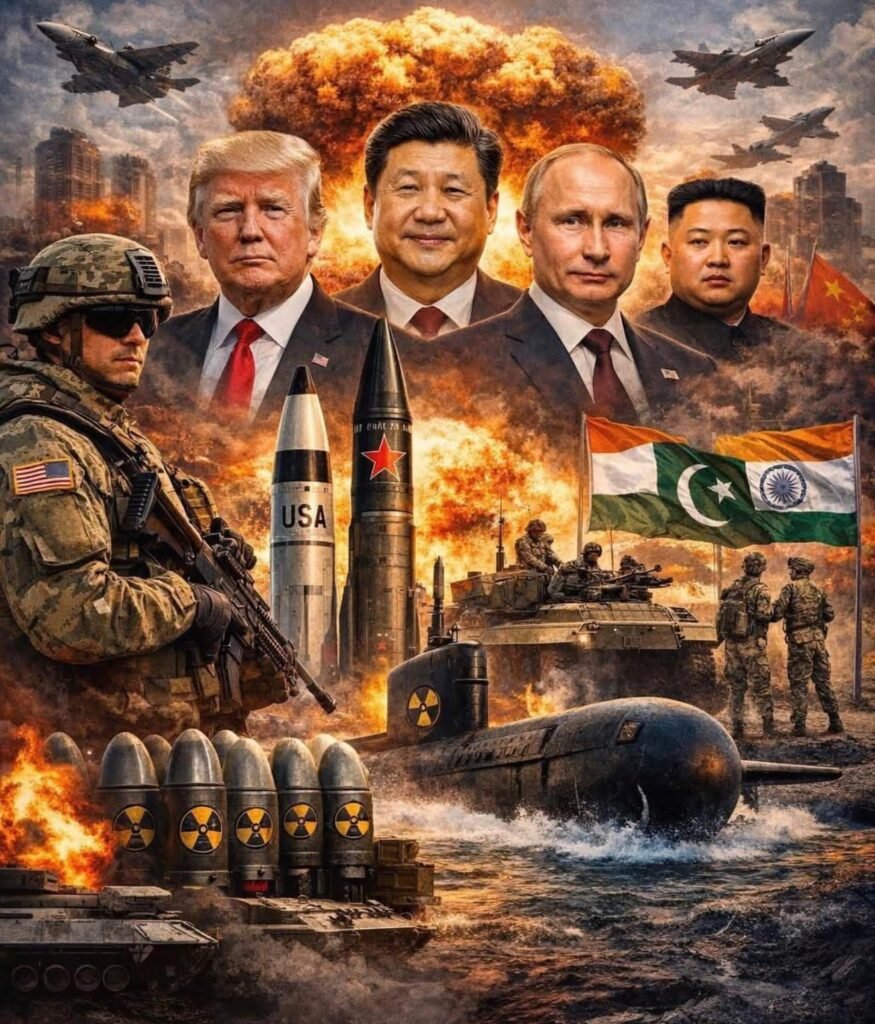
The United States, Russia, and China remain at the center of this escalation. All nine nuclear-armed countries including the US, Russia, China, the UK, France, India, Pakistan, North Korea, and Israel continued to modernize their nuclear arsenals in 2024. According to international estimates, the world now possesses over 12,000 nuclear warheads, with nearly 90% controlled by Washington and Moscow.
China’s rapidly expanding nuclear capability has emerged as a major strategic concern, particularly in the Indo-Pacific region. At the same time, cracks are appearing within Western alliances, as Europe debates greater military autonomy and expanded nuclear deterrence amid uncertainty over long-term US commitments.
In Asia and the Middle East, rising tensions ranging from the Korean Peninsula and Taiwan to Iran and Israel are further fueling militarization. Strategic partnerships, nuclear-powered submarines, and advanced missile systems are becoming central tools of deterrence.
Eighty years after Hiroshima and Nagasaki, the normalization of nuclear expansion once again places humanity at risk. Analysts warn that unlike conventional wars, a nuclear conflict would offer no economic or strategic gain only irreversible devastation for the entire world
