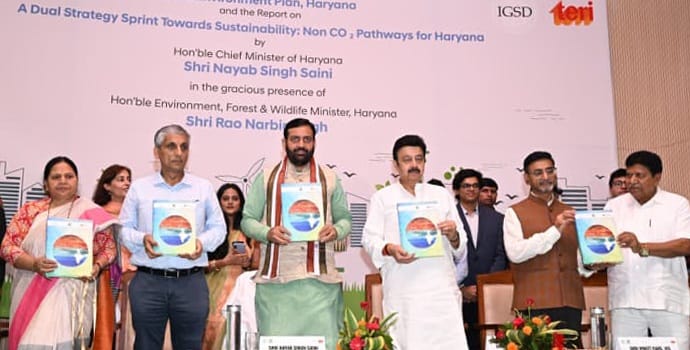
Chandigarh, September 16 – Haryana has taken a decisive step towards sustainable development and pollution control with the launch of the State Environment Plan-2025. Chief Minister Nayab Singh Saini unveiled the plan in Panchkula along with the release of the Non-CO2 Pathways Report 2025-26, terming it a milestone in the state’s journey toward environmental protection.
The plan is designed to improve air quality, cut pollution levels, and provide citizens with a clean and safe environment. It will also strengthen Haryana’s position in meeting national and global sustainable development goals.
The government has announced the establishment of 13 integrated solid waste management plants across the state to handle over 5,600 tonnes of daily waste. Nearly half of the legacy waste at dumping grounds has already been cleared, while efforts are underway to process the remaining. To tackle the growing challenge of electronic waste, the state aims to set up e-waste collection centres in every district, supported by 42 recyclers already in operation.
Highlighting biomedical waste disposal, the Chief Minister said that around 22 tonnes generated daily from 7,000 hospitals is being fully treated at 11 common facilities. For industrial hazardous waste, a central disposal site in Faridabad’s Pali ensures safe management.
Addressing air pollution, Haryana has joined hands with the World Bank to roll out a ₹3,600 crore Clean Air Project for Sustainable Development. Under this, 500 electric buses will be deployed in Gurugram, Faridabad, and Sonipat, along with subsidies for electric autos, gas-based generators, and advanced monitoring systems. The state is also in the process of adding 375 electric buses to city services, with more than 370 EV charging stations already installed.
Efforts to reduce stubble burning have yielded results, with incidents dropping by 90% since 2016 thanks to over one lakh machines distributed to farmers. To strengthen monitoring, the state plans to install 18 new air quality stations in addition to the 75 already operational.
Water management has also been prioritized, with 201 sewage treatment plants in operation and projects underway to reuse treated water for irrigation. Rewari’s Masani Barrage is being developed as a pilot model for statewide adoption.
CM Saini appealed to citizens to join the mission by conserving water, planting trees, and keeping their surroundings clean. He emphasized that the initiative is not limited to government departments but requires participation from every section of society.
Environment Minister Rao Narbir Singh, who also addressed the event, warned that unchecked pollution could endanger future generations, especially in NCR where air quality often ranges between 200 and 500 AQI. He stressed the need for waste segregation, reduction of plastic use, and greater public awareness to ensure long-term change.
With this plan, Haryana has become the first state in the country to launch a comprehensive mission dedicated to environmental protection, marking a significant step toward a sustainable and resilient future.