

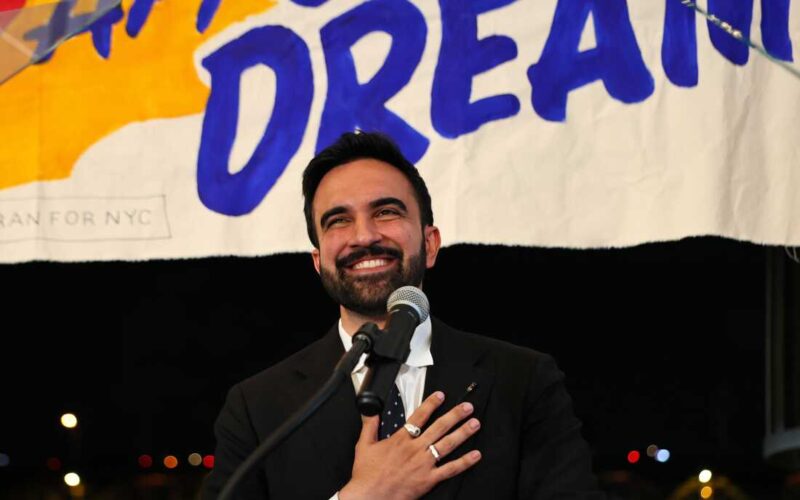
NEW YORK (Rajeev Sharma): In a stunning political upset, 34-year-old Zohran Mamdani has been elected mayor of New York City, marking a milestone as the city’s first Indian-American Muslim leader. The progressive lawmaker’s win has redrawn the political landscape of America’s largest city, ushering in a new era of left-leaning politics.
Defeating veteran politician and former governor Andrew Cuomo, along with Republican contender Curtis Sliwa, Mamdani’s victory capped a whirlwind campaign built on community organizing, affordability, and optimism. His supporters say his rise reflects a growing appetite for change in a city strained by housing costs and inequality.
A New Face in City Hall
Mamdani’s campaign was powered by volunteers rather than political elites. His message focused on making New York more livable for working families—promising free childcare, fare-free public buses, and affordable groceries through city-operated stores. He also proposed creating a Department of Community Safety to deploy mental health workers for certain 911 calls, a shift away from heavy police reliance.
Critics have questioned how these ambitious policies will be funded. Governor Kathy Hochul has publicly opposed Mamdani’s proposal to tax the ultra-wealthy, setting the stage for an early clash between Albany and City Hall.
The Fall of a Political Giant
Cuomo entered the race as the presumed frontrunner, seeking redemption after his resignation amid sexual harassment allegations—charges he has denied. However, his campaign failed to regain the public’s trust. His attacks on Mamdani’s lack of executive experience and progressive views backfired, especially among younger voters craving new leadership.
Mamdani’s charisma and community engagement steadily eroded Cuomo’s lead. By the time of the Democratic primary, Mamdani had turned what once seemed an impossible bid into a citywide movement. His eventual win by a comfortable margin confirmed a clear shift toward progressive politics.
A Symbol of Representation
Born in Kampala, Uganda, Mamdani moved to New York as a child and became a U.S. citizen in 2018. His victory resonates deeply with immigrant and Muslim communities, who see his success as proof that New York’s diversity is not just symbolic but powerful in shaping its leadership.
“It’s not just about who he is—it’s about what he represents,” said activist and campaign volunteer Samira Khan. “For the first time, many of us feel truly seen in city politics.”
Controversy and Conviction
Mamdani’s outspoken support for Palestinian rights became a focal point late in the campaign. Opponents accused him of divisiveness, but he stood firm, emphasizing his belief in justice and human rights. His approach—measured yet unapologetic—earned both criticism and admiration, reflecting the polarized but passionate nature of modern city politics.
On policing, Mamdani struck a conciliatory tone after once calling for defunding the NYPD. He has since said he wants to work with police leadership to ensure accountability while improving community relations.
Looking Ahead
As Mamdani prepares to assume office next year, expectations are high. His promises to tackle housing affordability, expand public services, and make the city fairer will face immediate fiscal and political challenges. Yet, his supporters insist his victory itself is proof of what can be achieved through collective action.
“New York has always been a city of reinvention,” said political analyst Carlos Vega. “Mamdani’s election is the clearest sign yet that voters are ready for a different kind of leadership—one that listens more than it lectures.”
With his hand raised high on election night, Mamdani pledged to govern for “the New York that struggles, not just the New York that shines.”
His win, both historic and symbolic, has made one thing certain: the city that never sleeps has just awakened to a new political dawn.
