

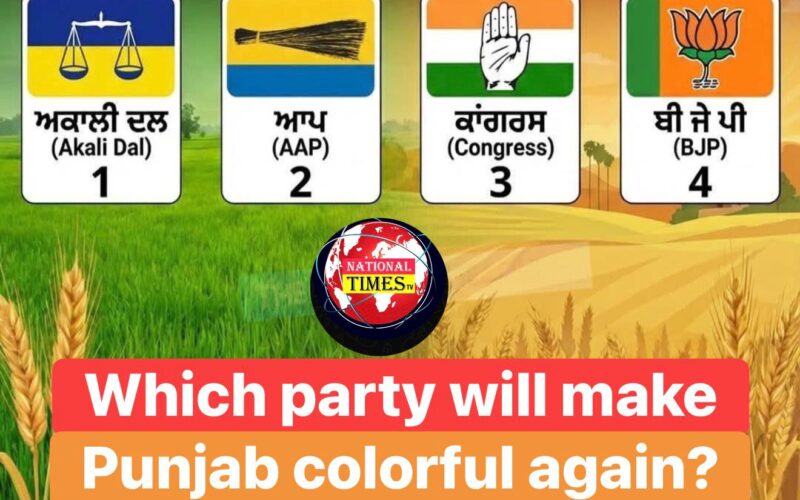
Chandigarh ( Gurpreet Singh): As Punjab heads toward the 2027 Legislative Assembly elections, citizens are increasingly discussing which political party can bring real progress and stability often referred to as making Punjab “colorful again.” Recent local elections and a comprehensive survey by National Times Media provide insights into public sentiment across the state.
The ruling Aam Aadmi Party (AAP) has focused on welfare programs, healthcare, education, and public services. In local body elections held in December 2025, AAP-backed candidates won around 45 percent of contested Gram Panchayat seats and performed strongly in district councils and panchayat samiti polls, signaling continued grassroots support. Chief Minister Bhagwant Mann described these results as an endorsement of government policies, while opposition parties such as the Congress, Shiromani Akali Dal (SAD), and BJP expressed concerns about turnout and alleged irregularities. Turnout for these local elections was approximately 48 percent.
To capture voter opinion more comprehensively, the National Times Media conducted a survey of 5,000 people across both rural and urban areas of Punjab, covering districts including Amritsar, Ludhiana, Jalandhar, Patiala, Bathinda, Mohali, and Moga. The survey found that 41% of respondents favored AAP, citing governance reforms and improved public services. The Congress received 24% support, praised for its experience and grassroots presence. SAD secured 19 % support, particularly in rural areas where its regional identity resonates. BJP accounted for 11 % support, mainly in urban pockets highlighting national-level leadership and development policies. Notably, 5 % of respondents remained undecided, saying their choice would depend on parties’ performance in the coming months.
Voices from across Punjab reflect this diversity. Jaideep Singh, a farmer from Moga, said that meaningful change depends on stable policies and fair crop pricing. Navneet Kaur, a student from Amritsar, emphasized job opportunities and education within Punjab. A small business owner in Ludhiana highlighted the need for political stability and infrastructure, while a retired official in Patiala stressed honest leadership and tangible results.
Political analysts suggest that while AAP currently enjoys an edge in both local elections and public opinion, opposition parties are actively mobilizing in their traditional strongholds. The combination of local election outcomes, National Times Media survey data, and public discussion indicates that voters are increasingly performance oriented rather than loyal to any single party.
As the 2027 elections approach, Punjab’s citizens are sending a clear message, the party that delivers development, transparency, and responsiveness to the real needs of the people will have the best chance to make Punjab truly “colorful again.”
