

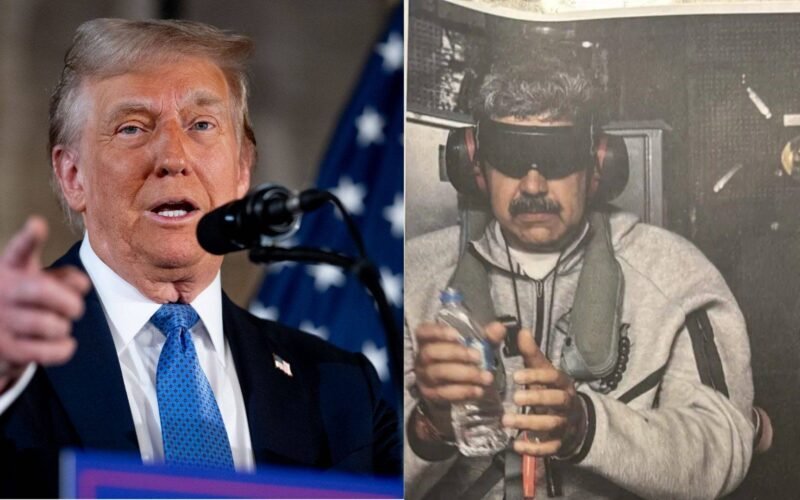
Washington/Caracas (Rajeev Sharma): In an unprecedented move that has sent shockwaves across the region, US President Donald Trump said on Saturday that the United States would temporarily assume control of Venezuela following the removal of President Nicolás Maduro, with plans to revive and utilise the country’s vast oil resources.
The announcement came hours after a covert military operation led to Maduro and his wife being taken into US custody and flown out of Venezuela. Trump described the action as part of a broader effort to stabilise the country, combat drug trafficking and restructure its collapsing energy sector. He said Washington intended to repair damaged oil infrastructure and sell Venezuelan crude to international buyers.
The operation followed months of mounting pressure by the Trump administration and marked the most direct American intervention aimed at regime change in decades. Legal experts and lawmakers, however, quickly questioned the legitimacy of the move, noting that it was carried out without formal authorisation from the US Congress.
Maduro Transferred to US Custody
US officials said Maduro and his wife were detained overnight at a military base residence and transported first to a US naval vessel before being flown to New York. Footage released by the White House showed the former Venezuelan leader under escort by federal agents at a Drug Enforcement Administration facility.
The Justice Department unveiled a fresh indictment accusing Maduro and his wife of leading a criminal network linked to drug trafficking, portraying the former government as illegitimate and corrupt. Maduro is expected to remain in federal custody in Brooklyn while awaiting trial.
Emergency Declared in Venezuela
In Caracas, explosions and low-flying aircraft were reported in the early hours of Saturday as the operation unfolded. Venezuelan authorities said several military and civilian sites were hit, leading to power outages and panic in parts of the capital.
Vice President Delcy Rodríguez condemned the action and demanded Maduro’s immediate release, calling him the country’s lawful president. Venezuela’s top court later instructed Rodríguez to assume interim leadership, though she initially rejected the role, insisting Maduro remained in charge.
Despite Trump’s claim that the US was already stepping in to govern Venezuela during a transition period, state television continued to broadcast pro-government messages and images of supporters rallying in the streets.
Oil and Security at the Core
Trump said the United States’ involvement would help curb the flow of narcotics into North America and restore economic order in Venezuela. He also highlighted the strategic importance of the country’s oil reserves, the largest in the world, suggesting that increased American oversight would benefit global energy markets.
The intervention followed weeks of intensified US military activity in the region, including strikes on vessels suspected of drug trafficking and a reported CIA-led drone strike on a Venezuelan docking facility last week.
Mixed Reactions at Home and Abroad
Reactions within Venezuela were sharply divided. Supporters of the ruling party protested Maduro’s removal, while others expressed relief or remained indoors amid uncertainty and fear. In some neighbourhoods, electricity had yet to be fully restored hours after the operation.
Outside the country, members of the Venezuelan diaspora in the United States celebrated the development, gathering in parts of Florida with flags and chants calling for political change.
Meanwhile, concerns over international law and sovereignty intensified. Several US lawmakers demanded briefings from the administration, questioning the legal grounds for the intervention. An emergency meeting of the United Nations Security Council has been requested to discuss the situation.
As Venezuela enters a new and uncertain chapter, the long-term consequences of Washington’s decision to intervene directly — and to temporarily administer the country — remain unclear, both for the region and the global order.
