

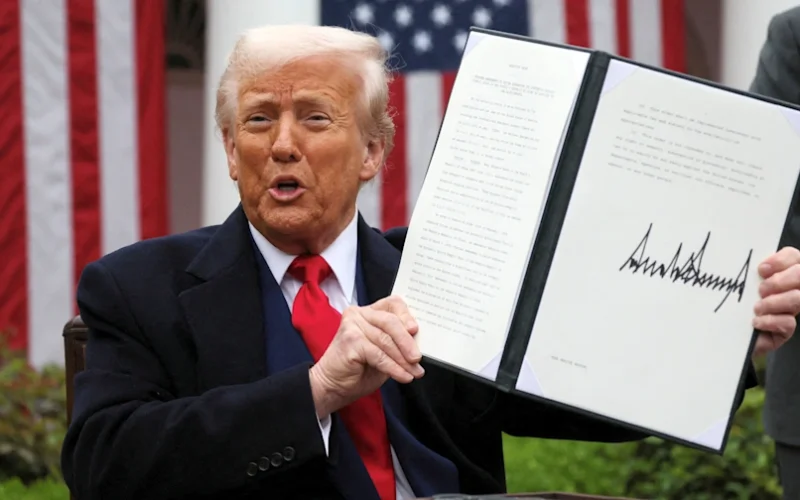
Washington DC (Rajeev Sharma): In a swift escalation of transatlantic and transpacific trade tensions, U.S. President Donald Trump has increased his newly proposed global tariff to 15%, just 24 hours after initially setting it at 10%. This defiant move follows a landmark 6-3 Supreme Court ruling on Friday, February 20, which struck down the administration’s previous emergency-based tariff regime as unconstitutional. The Court ruled that the President exceeded his authority by using national emergency laws to impose broad taxes on imports—a power that belongs exclusively to Congress.
President Trump sharply criticized the judicial decision as “ridiculous” and “anti-American,” immediately pivoting to a different legal authority. He signed a new proclamation under Section 122 of the Trade Act of 1974, which allows for a temporary 150-day “import surcharge” of up to 15% to address international balance-of-payments deficits. While the President describes these new levies as “legally tested,” they are capped by a strict five-month window unless Congress votes to extend them.
Legal Controversy and Constitutional Conflict
The administration’s reliance on Section 122 has already sparked a fresh legal battle. Neal Katyal, the Indian-origin constitutional lawyer who led the successful Supreme Court challenge, argued that the President’s new move lacks a sound legal basis. Katyal pointed out that the government’s own Justice Department previously argued that Section 122 did not apply to “trade deficits,” which are distinct from the “balance-of-payments” crises the law was intended to solve. Katyal challenged the President to seek Congressional approval if his policies are “such a good idea,” noting that the U.S. Constitution requires legislative consent for taxation.
The “Reset” for India-U.S. Trade
The sudden policy shift has introduced fresh volatility into India’s trade relationship with the United States. Only weeks ago, New Delhi and Washington had negotiated an Interim Trade Agreement that was set to lower the reciprocal tariff on Indian goods from 25% to 18%. The Supreme Court’s Friday ruling briefly promised even deeper relief, potentially resetting Indian export duties to a baseline average of approximately 8.2% by removing the “emergency” layers.
However, the new 15% global surcharge effectively erases those potential gains. While a 15% rate is nominally lower than the 18% negotiated in the interim deal, it acts as a “stackable” surcharge on top of certain existing duties. Analysts suggest that for many Indian sectors—including textiles, pharmaceuticals, and engineering goods—the effective tariff could now hover around 18.5%. This reset forces Indian commerce officials back to the negotiating table, as previous bilateral concessions appear to have been superseded by the President’s universal surcharge.
