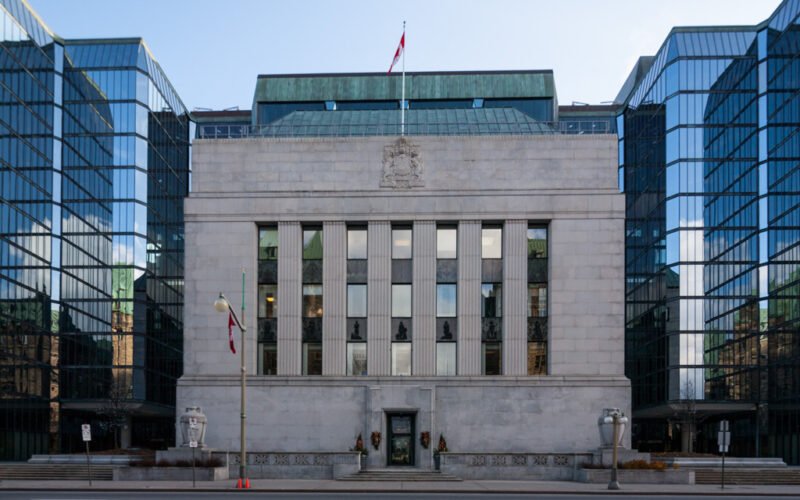
Bank Of Canada

Bank of Canada Announces Departure of Deputy Governors Toni Gravelle and Sharon Kozicki

Bank of Canada Announces Departure of Deputy Governors Toni Gravelle and Sharon Kozicki

Ottawa (Rajeev Sharma): The Bank of Canada announced on Monday, March 23, 2026, that Deputy Governors Toni Gravelle and Sharon Kozicki will be departing from their roles later this year. The central bank confirmed that both veteran policymakers have decided to retire after distinguished careers in public service and central banking. Toni Gravelle, who has overseen the Bank’s financial markets activities, will retire effective July 31, 2026. Sharon Kozicki, a key figure in monetary policy design and the first woman appointed as a Deputy Governor in over six years when she joined the Governing Council in 2021, will step down…
Read More
Canada Sheds 84,000 Jobs in February; Unemployment Rises to 6.7%

Canada Sheds 84,000 Jobs in February; Unemployment Rises to 6.7%

Ottawa (Rajeev Sharma) — Canada’s labour market suffered a major setback in February 2026 as the economy unexpectedly lost 84,000 jobs, driving the national unemployment rate up to 6.7%. According to the latest Labour Force Survey from Statistics Canada, the decline was far more severe than economists had predicted, marking one of the worst monthly job losses since the COVID-19 pandemic. The report comes at a sensitive time for the Canadian economy, which is currently grappling with trade uncertainty, new U.S. tariff investigations, and the ripple effects of the ongoing conflict in West Asia. Key Figures: A "Brutal" Month for…
Read More
Bank of Canada Warns Potential Rate Hikes May Be Necessary Despite Weak Economic Growth

Bank of Canada Warns Potential Rate Hikes May Be Necessary Despite Weak Economic Growth

Ottawa (Rajeev Sharma): The Bank of Canada has issued a cautious warning that interest rate increases may occasionally be required even during periods of economic stagnation, as the country prepares for significant structural shifts and potential global supply shocks. Speaking in Norway on Monday, March 2, 2026, Deputy Governor Sharon Kozicki addressed the "difficult trade-off" that central banks face when inflationary pressures are driven by supply-side disruptions rather than domestic demand. She noted that while it might seem counterintuitive to tighten monetary policy during a weak economy, such restraint is essential to prevent inflation from becoming persistent. Kozicki identified several…
Read More
Canada Economy on ‘Recession Watch’, Bank of Canada Must Cut Rates Further: Rosenberg

Canada Economy on ‘Recession Watch’, Bank of Canada Must Cut Rates Further: Rosenberg

Ottawa (Rajeev Sharma): Canada’s economy is effectively “on life support” and facing a clear recession risk in 2026, according to economist David Rosenberg, who says the Bank of Canada (BoC) will be forced to cut interest rates further to prevent a deeper slowdown. In a new report titled Canadian Economy on Life Support, Rosenberg Research warns that despite aggressive monetary easing since 2024, economic momentum remains weak. The Bank of Canada has slashed rates by 275 basis points from a peak of five per cent, yet per capita GDP continues to decline and overall economic growth is stuck at around…
Read More
Bank of Canada Holds Interest Rate at 2.25%, Sees Slow Recovery After U.S. Tariff Shock

Bank of Canada Holds Interest Rate at 2.25%, Sees Slow Recovery After U.S. Tariff Shock

Ottawa (Rajeev Sharma): The Bank of Canada held its benchmark interest rate steady on Wednesday, maintaining the policy rate at 2.25 per cent, while forecasting a gradual recovery the Canadian economy following the impact of U.S. tariffs The decision marks the central bank’s first rate announcement of the year and was widely anticipated by economists. The bank paused its rate-cutting cycle in December, and Governor Tiff Macklem said recent economic developments have largely unfolded in line with expectations. However, Macklem cautioned that uncertainty remains “unusually high,” citing ongoing geopolitical risks and the upcoming review of the Canada-U.S.-Mexico Agreement. He said…
Read More
Bank of Canada Lowers Benchmark Interest Rate to 2.5% in First Reduction Since March

Bank of Canada Lowers Benchmark Interest Rate to 2.5% in First Reduction Since March

Ottawa (Rajeev Sharma): The Bank of Canada has decreased its benchmark interest rate to 2.5%, marking its first rate cut since March, as the central bank responds to decelerating economic growth and easing inflationary pressures. The decision follows months of cautious signals from policymakers, who faced mounting pressure from households and businesses struggling with high borrowing costs. Economists note that the Bank’s move reflects a shifting economic landscape, where inflation has moderated closer to the 2% target, while GDP growth and consumer spending have slowed. This combination has provided policymakers with the flexibility to lower interest rates without exacerbating inflation.…
Read More
Bank of Canada Holds Interest Rate at 2.75%, Signals Caution Amid Trade Uncertainty

Bank of Canada Holds Interest Rate at 2.75%, Signals Caution Amid Trade Uncertainty

Ottawa, June 4, 2025 — The Bank of Canada (BoC) has kept its key interest rate steady at 2.75% for the second consecutive time, reflecting a measured approach as uncertainties surrounding global trade and domestic inflation continue to loom.Governor Tiff Macklem said the central bank reached a "clear consensus" to pause any rate changes during the current cycle. “At this decision, there was a clear consensus to hold policy unchanged as we gain more information,” Macklem stated, pointing to both progress and persistent risks influencing the Canadian economy.While Canada's GDP growth exceeded expectations in the first quarter, registering a 2.2%…
Read More
Canada Braces for Economic Storm as U.S. Tariffs Threaten Deep Recession

Canada Braces for Economic Storm as U.S. Tariffs Threaten Deep Recession

Ottawa, April 17, 2025: Canada's central bank has sounded the alarm, warning of a looming deep recession as trade tensions with the United States escalate. The Bank of Canada held its key interest rate at 2.75 percent—the first pause after seven consecutive cuts—citing uncertainty caused by U.S. tariffs and the threat of a prolonged global trade war.Governor Tiff Macklem acknowledged the gravity of the moment, calling it a “once-in-a-century economic shock.” He admitted the central bank could not offer reliable forecasts and instead laid out two stark scenarios. In the best-case outcome, tariffs are gradually rolled back through negotiation, leading…
Read More
Bank of Canada Hits Pause on Rate Cuts Amid Tariff Turmoil, Warns of Deep Recession Risk

Bank of Canada Hits Pause on Rate Cuts Amid Tariff Turmoil, Warns of Deep Recession Risk

Toronto, April 17, 2025 — The Bank of Canada froze its key interest rate at 2.75% on Wednesday, marking its first pause after seven consecutive rate cuts. The central bank cited major global uncertainties—particularly U.S. President Donald Trump’s sweeping tariffs—as the reason for halting its usual forward-looking economic projections.Governor Tiff Macklem said the bank would adopt a wait-and-watch approach. “The future is really no clearer,” he said, pointing to the unpredictable nature of trade tensions. With no clarity on how long the tariffs would last or whether they might intensify, the Bank of Canada replaced its quarterly economic outlook with…
Read More
The Bank of Canada (BoC) lowered its key interest rate by 25 basis points to 2.75 per cent

The Bank of Canada (BoC) lowered its key interest rate by 25 basis points to 2.75 per cent

Calgary, March 12, 2025( Rajeev Sharma): The Canadian economy ended 2024 in good shape. Inflation has been close to the 2% target since last summer. Substantial cuts to our policy rate through the second half of last year boosted household spending and economic growth. However, in recent months, the pervasive uncertainty created by continuously changing US tariff threats has shaken business and consumer confidence. This is restraining household spending intentions and businesses’ plans to hire and invest. Against this backdrop, and with inflation near the 2% target, Governing Council decided to reduce the policy rate a further 25 basis points.…
Read More