

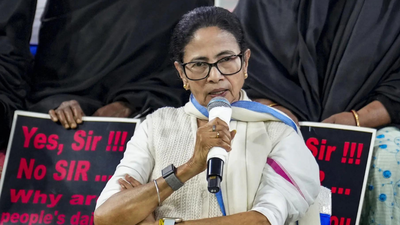
National Times Bureau :- The Supreme Court is scheduled to hear on Wednesday a batch of petitions challenging the Special Intensive Revision (SIR) of electoral rolls currently underway in West Bengal, a process that has triggered sharp political reactions in the state. All eyes are on West Bengal Chief Minister Mamata Banerjee, who may personally present arguments before the court after nearly three decades.
Known for her combative political style, Mamata Banerjee has been vocal in opposing the SIR exercise. After earlier criticising its implementation in Bihar, she has now approached the apex court against the rollout of the same process in West Bengal. The Trinamool Congress (TMC) has also filed separate petitions, terming the exercise arbitrary and harmful to voters’ rights.
According to the Supreme Court’s cause list, a bench headed by Chief Justice Surya Kant, along with Justices Joymalya Bagchi and Vipul M. Pancholi, will hear petitions filed by Mamata Banerjee, Mostari Bano, TMC MPs Derek O’Brien and Dola Sen, among others. Sources indicate that the Chief Minister may be present in court and could herself address the bench.
If Mamata Banerjee appears as a lawyer, it would mark her first legal representation in 32 years. She last argued a case on February 10, 1994, in a district court in West Bengal, when 33 accused were granted bail. A law graduate from Jogesh Chandra Chaudhuri Law College under Calcutta University, Banerjee briefly practised law before entering active politics.
Earlier, on January 19, the Supreme Court had issued key directions to the Election Commission regarding the SIR process, stressing that it must be conducted in a transparent manner and should not cause inconvenience to voters. The court had also ordered that names of voters placed in the “reasonable doubt” category be displayed at gram panchayat buildings and block offices, allowing people to submit documents and raise objections.
The Election Commission has stated that around 12.5 million voters have been classified under “reasonable doubt” due to discrepancies such as mismatches in parents’ names and age-related variations. In her petition filed on January 28, Mamata Banerjee described the process as a violation of democratic and constitutional rights, naming the Election Commission and the state’s Chief Electoral Officer as respondents.
The hearing is expected to have significant political and constitutional implications, particularly with national attention focused on electoral integrity and voter inclusion.
