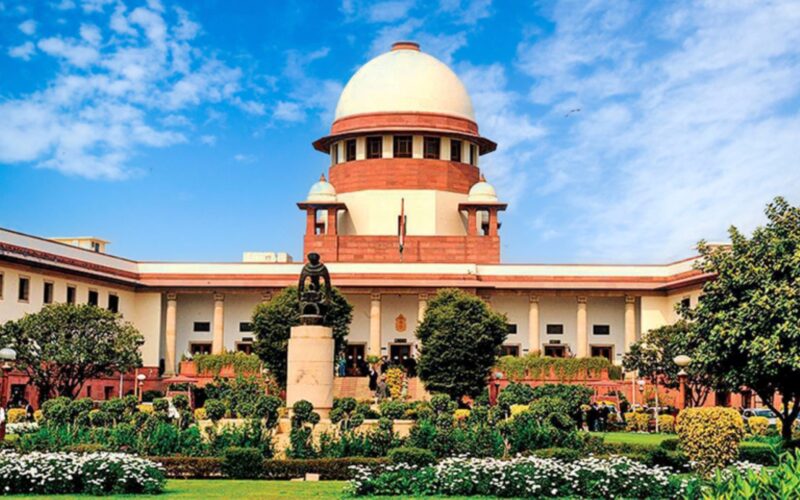
New Delhi, December 1 — The Supreme Court on Monday said the problem of air pollution in Delhi-NCR cannot be viewed as a “customary” matter taken up only in winter. In a major shift from past practice, the court announced it will hear the issue twice a month throughout the year to examine both short-term and long-term measures to tackle pollution.
A bench of Chief Justice Surya Kant and Justice Joymalya Bagchi said the matter demands continuous attention. The CJI stressed that stubble burning should not become a political or ego-driven debate. He questioned the common narrative that crop residue burning is the main reason behind Delhi’s pollution and recalled that during the Covid lockdowns, stubble burning continued, yet the skies were clear. He said this shows that several other factors contribute to the crisis.
The Chief Justice said it would be unfair to push the entire blame onto farmers, who have limited representation in court proceedings. The bench asked the Centre to explain the specific steps taken by agencies like the Commission for Air Quality Management (CAQM) and the Central Pollution Control Board (CPCB) to address pollution.
The court listed the matter for further hearing on December 10 and sought a detailed report within a week outlining immediate and long-term measures to curb factors other than stubble burning.
At the beginning of the hearing, the CJI noted that Delhi pollution cases should not be restricted to October hearings and must be reviewed regularly. He also pointed out that Monday’s Air Quality Index showed some improvement, joking that the listing of the case itself seemed to have an impact.
Additional Solicitor General Aishwarya Bhati, appearing for the Centre, said the major contributors to pollution include stubble burning, vehicular emissions, construction dust, road dust and biomass burning. She assured the court that she could provide a full list of steps taken under each category.
The CJI, however, emphasized that the real problem includes deep structural issues. He highlighted unplanned urban expansion, increasing population pressure and rising household vehicle ownership. He said Indian cities were never designed to handle such a scale of growth. He added that rapid development must not come at the cost of declining quality of life.
The bench said it will continue to monitor the implementation of pollution-control measures and ensure that hearings take place twice a month, not just during the winter months.
Supreme Court Says Delhi-NCR Air Pollution Cannot Be Treated as a Seasonal Issue, Orders Year-Round Monitoring
 0 Comments