

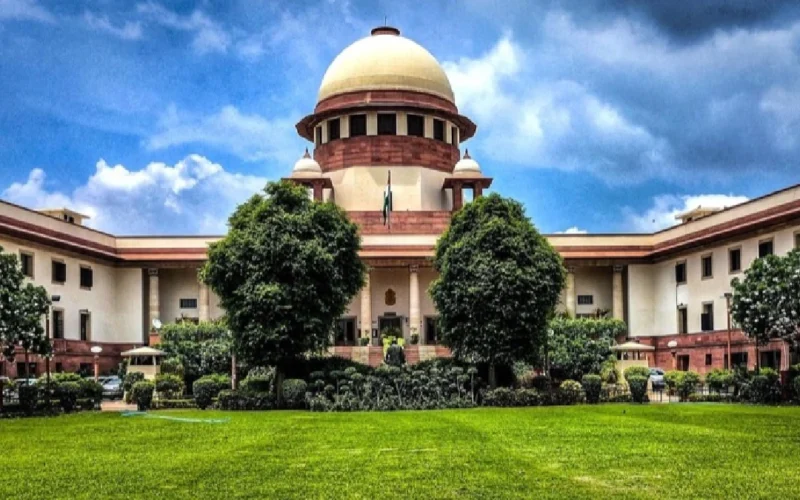
New Delhi (Gurpreet Singh)— A nine-judge Constitution Bench of the Supreme Court, led by Chief Justice of India Surya Kant, on Thursday reserved its judgment on the legal correctness of a landmark 1978 ruling that provided an expansive definition of the term “industry.” The verdict follows three days of intensive arguments concerning the Bangalore Water Supply and Sewerage Board v. A. Rajappa case, which has served as the bedrock of Indian labour jurisprudence for nearly half a century. The bench, which includes Justices B.V. Nagarathna, P.S. Narasimha, Dipankar Datta, Ujjal Bhuyan, Satish Chandra Sharma, Joymalya Bagchi, Alok Aradhe, and Vipul M. Pancholi, is tasked with deciding whether the “triple test” laid down in 1978—identifying an industry based on systematic activity, employer-employee cooperation, and the production of goods or services—remains sound in the modern economic landscape.
The Central Government, represented by Attorney General R. Venkataramani and Additional Solicitor General K.M. Nataraj, argued that the 1978 judgment’s broad interpretation has led to an “over-inclusion” that improperly brings sovereign functions and welfare activities under the ambit of the Industrial Disputes Act. The Attorney General clarified that while the government is not “anti-labour,” there is a critical need to distinguish between commercial enterprises and the state’s constitutional obligations, such as education, forest conservation, and public works. The Centre maintained that treating charitable institutions and sovereign departments as “industries” creates an undue burden on the state’s functional autonomy and could deter private investment in essential sectors.
Conversely, senior advocates including Indira Jaising, C.U. Singh, and Shekhar Naphade, appearing for various employee unions and states, defended the expansive definition as a necessary protection for workers. They contended that the Industrial Disputes Act is a beneficial piece of legislation designed to provide security of tenure and specialized remedies like reinstatement, which are unavailable in ordinary civil courts. Jaising emphasized that the nature of the activity—rather than the profit motive or the identity of the employer—should remain the decisive factor, arguing that workers in hospitals, universities, and welfare schemes deserve the same legal protections as those in traditional factories.
The case reaches a critical juncture as India transitions from the Industrial Disputes Act of 1947 to the recently enforced Industrial Relations Code of 2020. The bench noted that while the old Act was recently repealed, its interpretation remains vital for resolving thousands of pending disputes and transitional matters. The final judgment is expected to conclusively define “sovereign functions” and determine the limits of the state’s role as a “welfare actor” versus an “industrial employer.” By revisiting this 48-year-old precedent, the Supreme Court aims to resolve long-standing judicial confusion and provide a balanced framework that protects labour rights without stifling the state’s primary governance duties.
