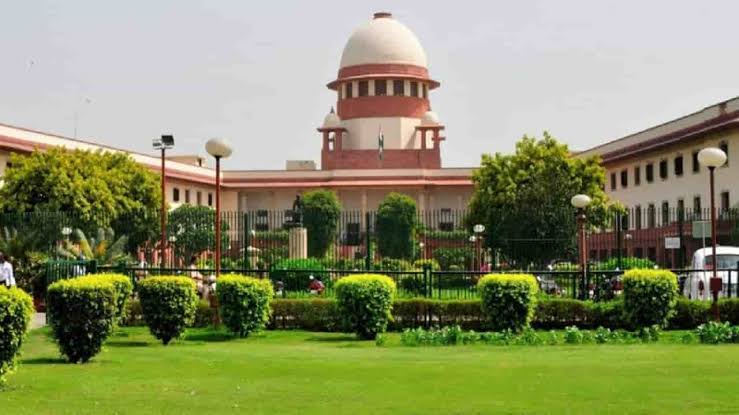
New Delhi, November 19, 2025 — The Supreme Court on Wednesday ruled that construction workers who lost their livelihoods due to the enforcement of GRAP-III in Delhi, Punjab, Haryana, and Rajasthan must receive subsistence allowance from their respective state governments. The direction came during a hearing on rising air pollution and the measures taken to control it.
A bench headed by Chief Justice of India B.R. Gavai instructed the four states to strengthen preventive actions aimed at reducing pollution levels and to ensure that all reviews of these measures are conducted regularly. The court further ordered that all cases dealing with air pollution must be listed every month to maintain consistent judicial oversight.
The bench noted that steps taken to curb toxic air are necessary but stressed that authorities must consider the hardships faced by people whose livelihoods are affected. “Any proactive action intended to cut down pollution is welcome, but decision-makers must weigh all factors and safeguard stakeholders,” the court observed.
GRAP-III, implemented on November 11 by the Commission for Air Quality Management, imposes tighter restrictions in the National Capital Region. These include a ban on most non-essential construction activities, curbs on BS-III petrol and BS-IV diesel four-wheelers, suspension of primary classes in schools with a shift to hybrid or online mode, restrictions on industries using non-clean fuel, and a ban on non-emergency diesel generator sets.
Earlier this week, the Supreme Court asked the Delhi government to submit an affidavit describing the monitoring equipment used to measure the Air Quality Index and its accuracy. The direction followed concerns raised by amicus curiae Aparajita Singh, who told the bench that water tankers had been used around pollution monitoring stations to artificially lower AQI readings. She also said that incidents of stubble burning were being underreported and urged the government to provide farmers with machinery to manage crop residue.
Appearing for the Centre, Additional Solicitor General Aishwarya Bhati said that water sprinkling was carried out across Delhi as part of pollution-control efforts, adding that political groups were circulating selective videos to create confusion.
The court directed the Chief Secretaries of Punjab and Haryana to ensure full implementation of CAQM’s November 13 directive on controlling stubble burning. It also asked the Centre to work on a long-term strategy to tackle air pollution across affected states.
During the hearing, senior advocate Gopal Sankaranarayanan argued that all construction activities in Delhi should be halted due to worsening air quality. The bench rejected the suggestion, stating that the graded restrictions under GRAP-III were designed by experts using scientific data. “A large section of the population depends on these activities for their livelihood. We cannot order a complete shutdown,” the court said.
Supreme Court Orders Subsistence Support for Construction Workers Affected by GRAP-III Restrictions
 0 Comments