

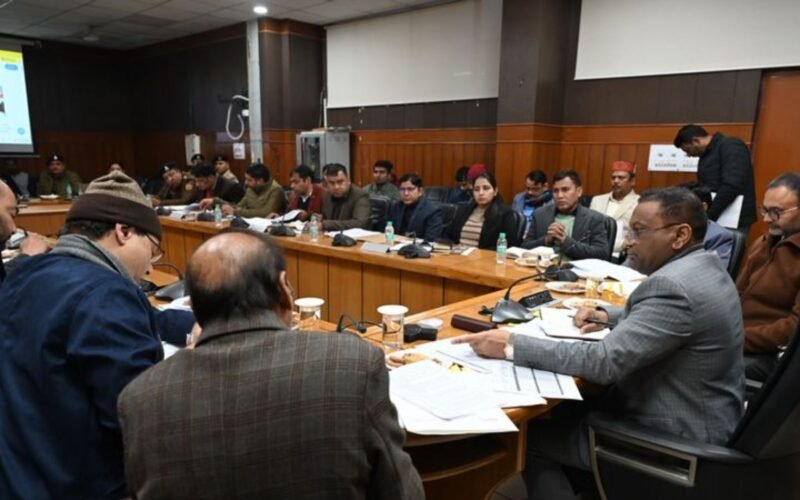
Chandigarh, January 3: A high-level departmental review meeting was held in Gurugram to ensure effective implementation of the Yamuna Action Plan, with a focus on pollution control measures in Gurugram and Jhajjar districts. The meeting was chaired by Haryana Pollution Control Board (HPCB) Member Secretary Yogesh Kumar, who issued clear directions for the time-bound and effective execution of all approved action points.
During the meeting, a detailed review was conducted of the action plans prepared to make Gurugram’s Badshahpur Lake 1, 2 and 3, as well as Drain No. 8 and Mungeshpur Drain in Jhajjar district, pollution-free. The Member Secretary sought progress reports from concerned departments and stressed that all measures must be implemented strictly as per the approved timelines.
Discussions during the meeting covered key issues related to Yamuna cleanliness, sewerage management, illegal waste dumping, functioning of sewage treatment plants (STPs), and solid waste management. HPCB Chief Engineer Balraj Ahlawat, Technical Advisor Baburam, and Senior Environment Engineer Jitendra Pal were also present.
Yogesh Kumar expressed serious concern over reports of tanker mafias illegally dumping sewer waste in open areas and drains within the municipal limits of Gurugram. Calling it a grave violation of environmental norms and law, he directed police officials to take strict action against the offenders, including issuing challans and registering FIRs wherever required, to set a strong deterrent example.
He instructed all departments to strictly adhere to the Standard Operating Procedures (SOPs) prepared for STPs. Officials were asked to conduct ground-level verification of compliance with each SOP parameter and submit point-wise reports with observations in the next review meeting. Emphasis was also laid on household sewer connections, with directions to prepare a comparative report detailing the number of connections earlier and at present. A special drive was ordered to connect more households to the sewer network, along with large-scale public awareness programmes.
The Member Secretary also directed that maximum utilisation of treated water from STPs be ensured, particularly for green belts and parks, including in private colonies. He made it clear that illegal industrial units would not be tolerated and instructed departments to take stringent action against such units as per rules.
On solid waste management, officials were asked to prepare a detailed report on the quantity of waste removed during drain cleaning operations. Directions were also issued to ensure that no garbage or plastic waste is dumped into drains. Regular monitoring of sludge generated from STPs was ordered to assess whether the plants are functioning as per prescribed standards. Action was also directed against illegal Ready Mix Concrete (RMC) plants under relevant norms.
Stressing inter-departmental coordination, Yogesh Kumar said all departments must work collectively to achieve the objectives of the Yamuna Action Plan and contribute effectively towards making the Yamuna river clean and pollution-free.
After the meeting, the Member Secretary inspected air quality monitoring stations located at Vikas Sadan and Sector-51. He reviewed their functioning, technical systems, real-time data recording, equipment performance, and maintenance status. Officials were instructed to ensure regular monitoring, data accuracy, and transparency, and to address any technical issues promptly, noting that air quality data plays a crucial role in shaping pollution control strategies.
