

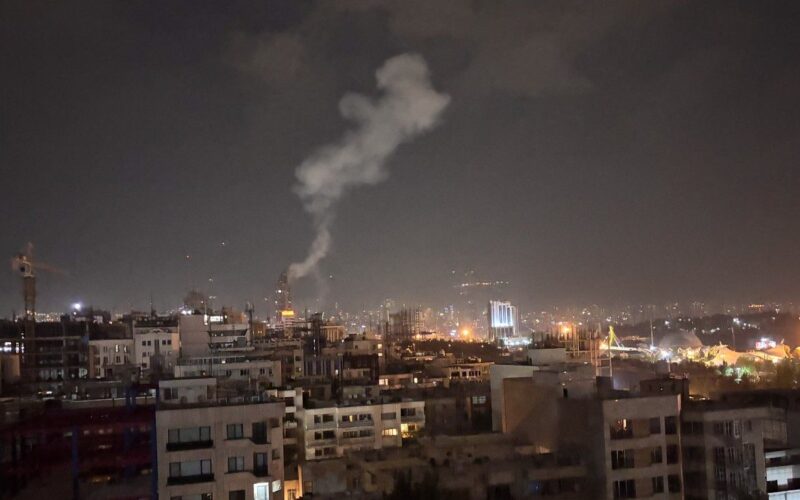
Tehran (Rajeev Sharma): Missiles streaked across the skies over Israel early Thursday as Iran launched another round of attacks, pushing the ongoing war into its sixth day. Air raid sirens sounded in several cities after Israeli defence forces confirmed incoming projectiles, even as the country widened its own military campaign beyond its borders.
The latest escalation follows reports that a US submarine sank an Iranian naval vessel in the Gulf, an incident that further inflamed tensions between Tehran and Washington. In response, Iranian officials warned that both military and economic targets across the region could face retaliation if hostilities continue.
Almost simultaneously, Israel announced renewed strikes in Lebanon aimed at infrastructure linked to Hezbollah. Explosions were reported in Beirut’s southern districts, long viewed as a stronghold of the Iran-backed group. The Israeli military said the operations were part of a broader strategy to counter threats emanating from multiple fronts.
Inside Iran, the pace and scale of bombardment have disrupted national events. State media said mourning ceremonies for Supreme Leader Ayatollah Ali Khamenei — who was killed in the opening phase of the conflict — have been postponed due to security concerns. The announcement marked a stark moment for the Islamic Republic, recalling the massive funeral procession held for Ayatollah Ruhollah Khomeini in 1989.
Washington has stood firmly behind Israel’s actions. US President Donald Trump praised American forces for their performance, while Republican lawmakers in the Senate blocked an effort to limit US participation in the war. The administration has indicated that curbing Iran’s missile and nuclear capabilities remains a priority, though officials have offered differing signals on whether regime change is an explicit objective.
The conflict is no longer confined to two nations. Iranian missiles were reportedly launched toward Bahrain and Kuwait, and Turkey stated that NATO defence systems intercepted a ballistic missile before it could breach Turkish airspace. Governments across the region have increased military readiness amid fears of further spillover.
Humanitarian and economic consequences are mounting rapidly. Iranian authorities report that more than 1,000 people have been killed since the fighting began. Lebanon has recorded over 70 fatalities, while Israel has confirmed around a dozen deaths. The violence has also shaken global markets, with energy supplies disrupted and shipping routes affected. Thousands of travellers remain stranded as airspace closures ripple across the Middle East.
As missile exchanges continue and diplomatic efforts struggle to gain momentum, the war shows few signs of slowing. With each passing day, the confrontation grows more complex, raising the spectre of a broader regional crisis.
