

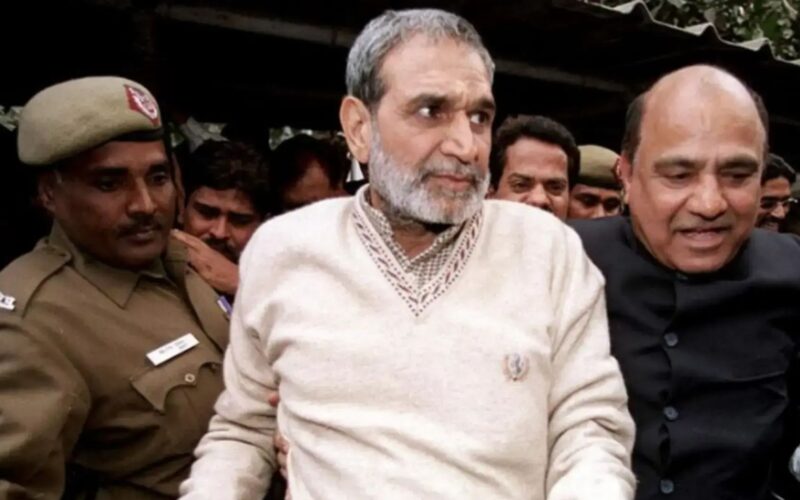
New Delhi (Rajeev Sharma): Former Congress MP Sajjan Kumar, one of the most prominent political figures convicted in connection with the 1984 anti-Sikh violence, died on Thursday at the age of 80.
Kumar, who had been serving a life sentence in Tihar Jail, was taken to Safdarjung Hospital after his health deteriorated. Hospital authorities confirmed his death.
His passing marks the end of a long and contentious chapter involving one of the darkest episodes in India’s recent history. Kumar had spent much of his later life fighting legal cases linked to the violence that erupted in Delhi following the assassination of Prime Minister Indira Gandhi on October 31, 1984.
From powerful MP to convicted prisoner
Kumar was once an influential Congress politician and represented Outer Delhi in the Lok Sabha three times. His political career, however, eventually became dominated by allegations concerning his role in the 1984 violence.
In December 2018, the Delhi High Court overturned his earlier acquittal and convicted him in a case involving the deaths of five Sikhs and the burning of a gurdwara in Delhi’s Raj Nagar area. The court sentenced him to imprisonment for the remainder of his natural life. Kumar surrendered and entered Tihar Jail later that month.
The conviction was regarded as a major development in the decades-long pursuit of justice in the 1984 cases, particularly because many investigations had remained unresolved for years.
Kumar resigned from the Congress shortly after the 2018 verdict, bringing an end to his formal association with the party.
Second life sentence in 2025
The legal proceedings against Kumar continued even after his imprisonment.
In February 2025, a Delhi court convicted him in another case arising from the 1984 violence. The case concerned the deaths of Jaswant Singh and his son, Tarundeep Singh, in the Saraswati Vihar area on November 1, 1984.
Kumar was sentenced to life imprisonment. The case had been investigated again following the reopening of several riot-related matters by the Special Investigation Team established in 2015.
The 2025 judgment meant Kumar was facing another life sentence even though he was already behind bars for the 2018 conviction.
Not every case ended in conviction
Kumar’s legal record also included acquittals.
In January 2026, a Delhi court cleared him in a separate case connected with alleged violence in Janakpuri and Vikaspuri during the 1984 riots. The court concluded that the prosecution had failed to establish his involvement beyond reasonable doubt.
The case involved allegations relating to violence, arson and killings during the riots. While the acquittal removed liability in that particular case, Kumar continued to remain in prison because of his other convictions.
His legal battles therefore produced differing outcomes, with convictions in some cases and acquittals in others.
Political career under a growing cloud
Kumar’s standing within the Congress declined steadily as scrutiny of the 1984 violence intensified.
Although he remained a Lok Sabha member until 2004, the controversy surrounding his alleged involvement eventually became a major political liability. By the 2009 general election, the Congress decided not to give him a ticket.
The party instead fielded his brother, Ramesh Kumar, from the constituency. Ramesh Kumar won the election but was defeated five years later.
Kumar’s political association with Congress formally ended after his 2018 conviction.
A case that remained in public memory
The 1984 anti-Sikh violence has remained one of the most painful and politically sensitive episodes in India’s post-Independence history. Thousands of Sikhs were killed in violence across Delhi and other parts of the country in the aftermath of Indira Gandhi’s assassination.
For victims’ families, the passage of time did not end the demand for accountability. The reopening of old cases and renewed investigations brought several long-pending matters back before the courts.
Kumar became one of the most recognisable political figures to face conviction in connection with the violence. His imprisonment, subsequent conviction in another case and later acquittal in a separate matter reflected the complicated and often uneven legal history of the 1984 cases.
With his death at 80, Kumar’s personal legal journey has come to an end. But the broader questions surrounding the violence of 1984, the experiences of survivors and the decades-long search for justice remain part of India’s continuing historical and political debate.
