

New Delhi (Gurpreet Singh): The Quad grouping of India, the United States, Japan and Australia on Tuesday condemned cross-border terrorism and announced fresh initiatives to strengthen maritime security, cybersecurity and cooperation in emerging technologies across the Indo-Pacific.
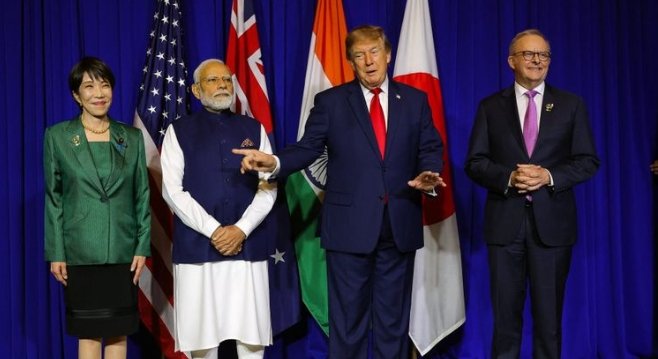
At the Quad Leaders’ Summit in Manila on November 17, Prime Minister Narendra Modi, US President Donald Trump, Australian Prime Minister Anthony Albanese and Japanese Prime Minister Sanae Takaichi also opposed unilateral attempts to change the regional status quo through force or coercion.
In their joint statement, the four leaders expressed concern over economic coercion, including arbitrary export restrictions, and reaffirmed their commitment to protecting freedom of navigation and overflight.
“We strongly oppose any destabilising or unilateral actions that seek to change the status quo, including by force or coercion,” the statement said, without naming any country.
Quad Launches Indo-Pacific Maritime Surveillance Collaboration
One of the key announcements was the launch of the Indo-Pacific Maritime Surveillance Collaboration, aimed at improving information-sharing and maritime domain awareness among the four countries.
As part of the initiative, their P-8 and P-3C maritime patrol aircraft are scheduled to participate in a joint exercise in 2027. It will be the first such exercise involving these aircraft in a Quad context.
The leaders also committed to working together to ensure open, safe and resilient maritime transit corridors across the Indo-Pacific.
Quad Announces AI And Cybersecurity Cooperation
The leaders reaffirmed their support for the Super Intelligence Accelerator, an initiative announced by Quad foreign ministers in Atlanta. The programme is intended to coordinate and fund efforts to expand access to trusted artificial intelligence, support its deployment and provide technical assistance across the Indo-Pacific.
The joint statement also announced enhanced Quad Cybersecurity Cooperation in response to the growing number and scale of cyber incidents in the region. The four countries said they would work together to promote an open and secure cyberspace.
Quad Business Leaders’ Forum To Be Held In 2027
The summit also saw the announcement of the inaugural Quad Business Leaders’ Forum, scheduled for early 2027.
The forum will bring together business leaders, government officials and policy experts from the four countries to encourage commercial partnerships and strengthen private-sector ties.
The leaders also welcomed progress under the Quad Partnership for Cable Connectivity and Resilience. Australia has expanded its contribution to include electricity cables, with the aim of strengthening regional energy security and connectivity.
They also welcomed upcoming undersea cable projects in the Indian Ocean to improve regional connectivity.
Quad Leaders Condemn Cross-Border Terrorism
On counterterrorism, the four leaders unequivocally condemned terrorism and violent extremism in all their forms and manifestations, including cross-border terrorism.
They pledged to strengthen ongoing cooperation within the Quad framework to address these threats.
The leaders also reaffirmed their support for ASEAN centrality and unity, reiterating their commitment to a free and open Indo-Pacific.
PM Modi Says Summit Gave Fresh Momentum To Indo-Pacific Vision
Prime Minister Narendra Modi described the meeting as productive and said it had given fresh momentum to the shared vision of a free, open, peaceful and prosperous Indo-Pacific.
In a post on X, Modi said the Quad remained committed to delivering trusted solutions for the region, covering maritime security, resilient supply chains, emerging technologies and disaster response.
The summit comes nearly a decade after the revival of the Quad and marks 10 years since the vision of a Free and Open Indo-Pacific was first articulated by former Japanese Prime Minister Shinzo Abe in 2016.
The four leaders described the grouping as a partnership focused on peace, stability and prosperity across the region.
