

Chandigarh (Gurpreet Singh): Reaffirming the Bhagwant Mann Government’s unwavering commitment to eliminate the menace of drugs, Punjab Health and Family Welfare Minister Dr. Balbir Singh on Tuesday said the Bhagwant Singh Mann Government’s ‘Yudh Nashean Virudh’ has emerged as a people’s movement that is delivering tangible results through a three-pronged strategy of strict enforcement, comprehensive treatment and rehabilitation, and sustained prevention.
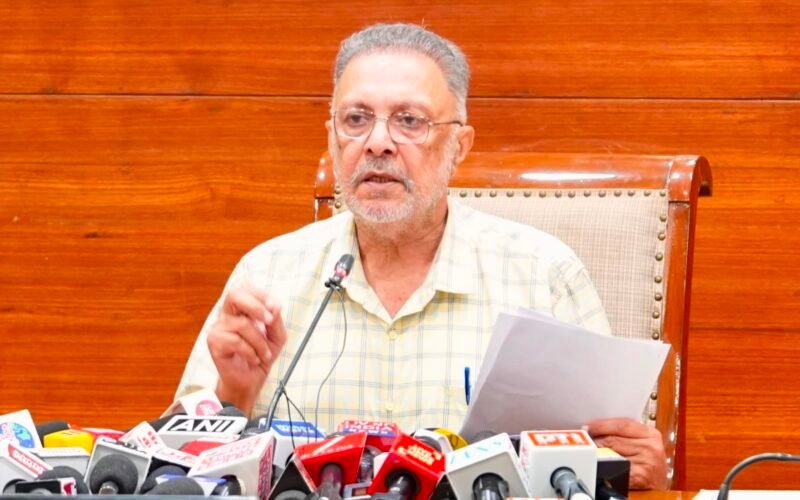
Addressing a press conference as the campaign completed 500 days, Health Minister Dr. Balbir Singh said the initiative, launched by CM Bhagwant Singh Mann under the vision of AAP National Convenor Arvind Kejriwal, is focused on protecting Punjab’s youth and securing the state’s future through a systematic and holistic approach. “The slogan of our campaign is ‘Protect, Heal and Prevent.’ This is not merely an anti-drug drive. It is a mission to save Punjab’s coming generations. CM Bhagwant Singh Mann and Arvind Kejriwal had promised the people that Punjab would be freed from the scourge of drugs, and today we are fulfilling that promise with honesty, determination and a well-planned strategy,” he said.
The Punjab Health Minister stated, “Our government has adopted a holistic approach by integrating the Police Department, Health Department, Education Department, Sports Department, Prisons Department and Social Security Department. The campaign is simultaneously targeting drug traffickers, treating those suffering from addiction and ensuring that future generations never fall into the trap of substance abuse.”
Highlighting the achievements of the campaign, Minister Dr. Balbir Singh said, “Since the launch of Yudh Nashean Virudh on March 1, 2025, 52,432 FIRs have been registered under the NDPS Act. More than 73,300 drug peddlers have been arrested across Punjab, including 621 big fishes caught with over 2 kilos of heroin. These figures reflect the seriousness with which the Bhagwant Mann Government is dismantling the drug network.”
He said the campaign has succeeded because it enjoys the confidence and active participation of the people. “The Safe Punjab Helpline (97791-00200) has received 46,342 public tip-offs during these 500 days, resulting in the arrest of 22,960 drug traffickers. This level of public participation clearly shows that people now trust the government and law enforcement agencies in the fight against drugs,” he said.
Comparing the government’s performance with previous administrations, the Health Minister said, “During ten years of the Akali government, 2,817 kg of heroin was recovered, while the Congress government recovered 2,412 kg in five years. Together, they seized 5,229 kg in fifteen years. In comparison, the Bhagwant Singh Mann Government has recovered 6,608 kg of heroin in just four years.”
“These figures speak for themselves. Honest intentions and clear policies have made this possible. Punjab has strengthened anti-drone surveillance and intensified enforcement against drug trafficking,” he added.
The Health Minister said the government’s action has gone beyond arrests. “The previous governments did not seize even a single major drug trafficker’s property. Our government has confiscated ₹847 crore worth of properties belonging to drug traffickers and demolished illegal structures built using money earned through the drug trade. Our message is clear: crime will not pay in Punjab,” he asserted.
Minister Dr. Balbir Singh said Punjab has also achieved one of the highest conviction rates in the country. “Our conviction rate in NDPS cases stands at 89 percent, which is among the highest in India. This reflects the quality of investigation and prosecution carried out under the Bhagwant Mann Government,” he said.
Emphasising the government’s rehabilitation efforts, Dr. Balbir Singh said Punjab has significantly expanded its treatment infrastructure. “Today, Punjab has 213 government and private de-addiction centres, 90 rehabilitation centres and 547 Outpatient Opioid Assisted Treatment (OOAT) clinics. Treatment at all government facilities is completely free of cost.”
“More than 10 lakh people have been registered under the OOAT programme. Since the launch of the campaign, more than 38,000 patients have received in-patient treatment at government de-addiction centres,” he said.
He further said, “The government has also given 10,917 individuals an opportunity to rebuild their lives by extending immunity from prosecution under Section 64A of the NDPS Act, enabling them to seek treatment instead of punishment.”
Speaking about prison reforms, Minister Dr. Balbir Singh said, “OOAT facilities have now been established in 19 jails, while dedicated de-addiction-cum-wellbeing clinics have been set up in 10 central jails to ensure that inmates battling addiction receive proper treatment and rehabilitation.”
Highlighting innovative initiatives, the Health Minister said, “Under the Soorma – Ambassador of Recovery Programme, people who have successfully overcome addiction are motivating others to seek treatment and begin a new life. Their stories are inspiring thousands of young people across Punjab.”
“We have also launched the Leadership in Mental Health Programme, India’s first government fellowship dedicated to strengthening preventive measures against substance abuse by engaging trained young professionals across the state,” he added.
Minister Dr. Balbir Singh said the government is focusing equally on prevention among children and adolescents. “We are training school teachers in Mental Health First Aid so they can identify early signs of substance abuse, counsel students and connect them with appropriate support. Schools are conducting mindfulness sessions and awareness programmes because prevention begins in classrooms,” he added.
He said the government has increased the capacity of de-addiction centres from 1,500 beds to 5,000 beds, appointed counsellors and clinical psychologists in medical colleges and district hospitals, introduced Liquid Methadone Therapy in six districts for injecting drug users and launched community-based follow-up programmes to reduce relapse.
“Our goal is not simply to help a patient quit drugs inside a de-addiction centre. We want every recovering individual to successfully reintegrate into society. Through our Community Bridge Programme, counsellors continue supporting patients even after they return to their villages,” he said.
Highlighting growing community participation, Minister Dr. Balbir Singh said, “More than 12,000 Village Defense Committees, comprising over 1.25 lakh members, are actively participating in awareness campaigns and helping law enforcement agencies by reporting drug trafficking. The Pinda Da Haal Action Plan and the statewide e-rickshaw awareness campaign have further strengthened grassroots participation.”
Raising concerns over cross-border drug smuggling, Minister Dr. Balbir Singh urged the Union Government to strengthen surveillance along the international border. “Punjab is being deliberately targeted because it shares an international border with Pakistan. While the Punjab Government has deployed anti-drone systems and strengthened enforcement, border security is the responsibility of the Central Government. Advanced surveillance technology is available, and drones carrying drugs can certainly be intercepted if there is the political will to do so.”
He also called upon the Centre to crack down on international drug syndicates and gangsters allegedly operating criminal networks from prisons outside Punjab. “The Centre must dismantle these organised criminal networks instead of allowing them to flourish. Punjab is fighting this battle on behalf of the entire nation, and it deserves full cooperation from the Union Government,” he said.
“The fight against drugs cannot be won by enforcement alone. It requires public participation, compassion, rehabilitation and a collective commitment to protect our youth. The Bhagwant Singh Mann Government will continue this mission until Punjab becomes completely drug-free,” Minister Dr. Balbir Singh added.
