

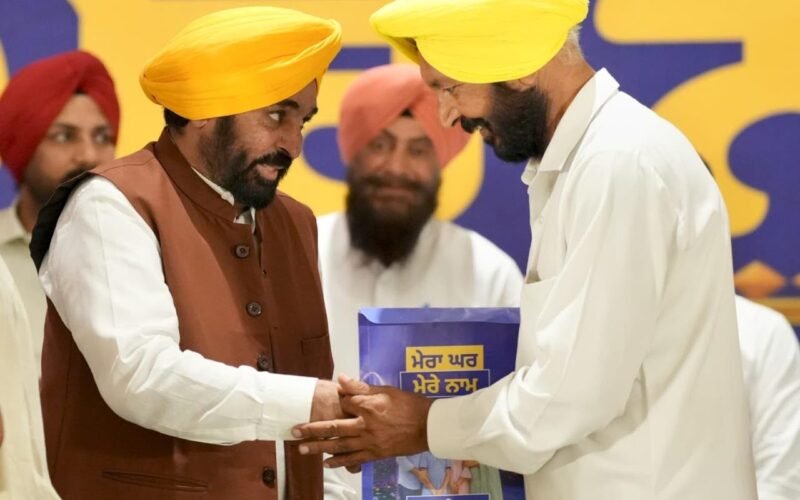
Dhuri (Gurpreet Singh): Chief Minister Bhagwant Singh Mann on Wednesday said Punjab has ended the decades-long wait for ownership rights to houses built in the Lal Lakir, handing Property Ownership Certificates to families under the ‘Mera Ghar Mere Naam’ scheme and marking the beginning of a process that will provide legally recorded ownership, mapped property boundaries and access to institutional credit. He said the initiative will particularly benefit poor, Dalit and landless families whose houses were earlier not part of government records, while accurate maps and revenue records will help resolve long-standing property disputes. After distributing the property ownership cards in Dhuri, CM Bhagwant Singh Mann said the State has also initiated the process of freeing Punjab from the Lal Lakir, with around 4,000 villages set to receive proper registrations soon.
Taking to X, CM Bhagwant Singh Mann stated: “The massive gathering at the Dhuri rally has proved that the echo of our work resonates in every household of Punjab. By ending politics centred around families, we have made a historic beginning towards freeing Punjab from the ‘Lal Lakir’. Around 4,000 villages will soon get proper property registrations. We have gifted Dhuri a ₹47 crore water project. With canal water reaching 88% of agricultural land right up to the tail ends, crop yields of our farmers have increased. Punjab being No. 1 in education and healthcare, and zero electricity bills, are now a reality. We are not going to be intimidated by the threats of central agencies. Our only objective is to serve Punjab selflessly, and Punjabis do not tolerate anyone’s intimidation. Inquilab Zindabad.”
Addressing the gathering, CM Bhagwant Singh Mann said, “The objective of the ‘Mera Ghar Mere Naam’ scheme is to provide every eligible family with a clear ownership right and documentary recognition of its own home. Our resolve is to ensure that the home of every eligible family is entered in the official records and that the family receives a document recognising its ownership. This initiative will strengthen the rights, dignity and future security of the people.”
The Chief Minister stated, “The massive gathering at the Dhuri rally has proved that the echo of our work resonates in every household of Punjab. By ending politics centred around families, we have made a historic beginning towards freeing Punjab from the Lal Lakir. Around 4,000 villages will soon get proper property registrations.”
He said, “Owning a home is deeply connected with every family’s emotions, aspirations and hopes for the future. Having a clear record of ownership of one’s home gives a family a sense of security and confidence. The key objective of the ‘Mera Ghar Mere Naam’ scheme is to ensure that no eligible family in Punjab feels insecure about its ownership rights over its home.”
CM Bhagwant Singh Mann said, “Several families in the villages have been living in their homes within the Lal Lakir for generations, and the absence of formal ownership records often creates various difficulties for them. A clear ownership document for a home where several generations of a family have lived is extremely important. The primary objective of the ‘Mera Ghar Mere Naam’ scheme is to provide eligible families with legal recognition of their ownership rights over their homes.”
Describing the scheme as a people-centric initiative, the Chief Minister said, “By providing people with ownership documents for their homes, the scheme is an important step towards addressing the long-standing gap in formal property records. A Property Card gives a family the assurance that the identity of its home and information relating to its ownership has been officially recorded.”
The Chief Minister said, “Under this scheme, drone surveys and modern technology are being used for the demarcation and mapping of properties. Through the survey, the location and boundaries of houses are being identified and ownership-related records are being prepared. The purpose of this process is to clearly establish people’s rights and bring greater transparency to property records, thereby reducing ambiguity regarding ownership in the future.”
He said, “With the issuance of Property Cards, eligible beneficiaries will receive documentary recognition and legal protection relating to the ownership of their homes. Clear records of house boundaries and ownership will help reduce misunderstandings and disputes relating to property ownership. The availability of formal property records can also facilitate the process of applying for loans from banks, but approval of any loan will remain subject to the concerned bank’s rules and eligibility criteria.”
He said the initiative will give people greater confidence to maintain and improve their homes and plan for their families’ future. “Our goal is to ensure that the benefits of this scheme reach every eligible family and that ownership records relating to their homes are clearly established,” he said.
Striking an emotional chord with the beneficiaries, CM Bhagwant Singh Mann stated, “I appeal to all beneficiaries to carefully verify the name, house details and other information mentioned on their Property Card. In case of any error or ambiguity, they should bring the matter to the notice of the concerned authorities.”
Giving details of the phased distribution, the Chief Minister said, “In the first phase, Property Cards are proposed to be distributed in 2,295 villages across Punjab, including 221 villages of Sangrur district. In the second phase, Property Cards will be distributed in 1,668 villages across Punjab. The third phase will run in November and the fourth in December.”
He said the phased distribution has been planned to ensure that Property Cards reach the maximum number of eligible beneficiaries in a smooth and systematic manner. “I appeal to the people to cooperate with the concerned teams during the survey, verification of records and distribution of Property Cards. This pro-people scheme is being implemented in mission mode and will cover the entire State by the end of this year,” he said.
CM Bhagwant Singh Mann also highlighted the development works being undertaken by the State Government, saying, “We have gifted Dhuri a ₹47 crore water project. With canal water reaching 88% of agricultural land right up to the tail ends, crop yields of our farmers have increased. Punjab being No. 1 in education and healthcare, and zero electricity bills, are now a reality.”
CM Bhagwant Singh Mann said, “We are not going to be intimidated by the threats of central agencies. Our only objective is to serve Punjab selflessly, and Punjabis do not tolerate anyone’s intimidation.”
Transparent Process To Give Families Secure Ownership Rights
The significance of ‘Mera Ghar Mere Naam’ lies not merely in handing over a Property Card, but in creating an official, verifiable Record of Rights for homes that were historically outside formal revenue records. Under the process, every house and plot in the notified abadi area is surveyed and mapped through modern technology, including drone mapping, while the owner is identified house by house by the Patwari or Survey Officer in the presence of the Village Level Committee. The draft map and ownership details are publicly displayed in the village and shared with the Panchayat, while owners receive their details on WhatsApp to verify the entries and seek corrections before the record is finalised. This transparent verification process gives families an opportunity to check their ownership details before they become part of the final Record of Rights.
Once finalised, the Record of Rights is formally attested and the Property Card is generated from it. The card carries the survey unit number, GPS location, drone map and QR code for online verification, giving the family a documented and verifiable record of its property. This is particularly significant for poor and Scheduled Caste families who have no land outside the abadi and for whom the house may be their only property. Formal recognition can provide greater security of ownership, help fix property boundaries and reduce disputes, while the property can also be offered as security for bank loans for business, farming, education or health. The record can further support registration, transfer and inheritance, with each co-owner’s share recorded. Gram Panchayats, meanwhile, get accurate maps of houses, roads, drains and public spaces for village development planning, while the administration gets digitised and accurate village records.
