

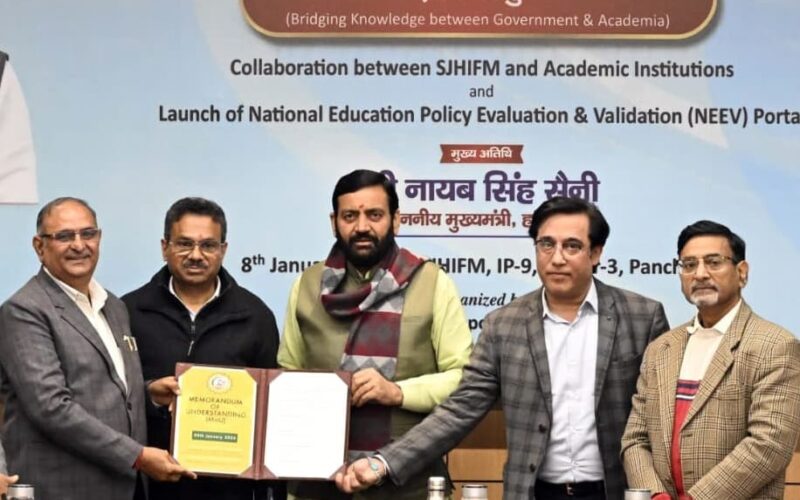
Chandigarh, January 8 — Haryana Chief Minister Nayab Singh Saini on Thursday said that the country has witnessed a clear and positive transformation over the last 11 years under the leadership of Prime Minister Narendra Modi. He stated that the effective implementation of public welfare policies has strengthened public trust, with citizens today feeling that the government truly represents them, which, he said, is the real essence of good governance. He added that there was a time when people believed governments merely completed five-year terms, but the situation has now changed as citizens seek visible, result-oriented governance rather than political change for its own sake.
Addressing a programme in Panchkula, the Chief Minister inaugurated the National Education Evaluation and Validation (NEEV) Portal, launched to support provisions of the National Education Policy and promote continuous academic assessment. In his presence, Memorandums of Understanding were also signed under the ‘Gyan Setu’ initiative between the Swarna Jayanti Haryana Institute for Fiscal Management and various universities.
Saini said the day marked a significant milestone in Haryana’s academic history, as the state’s education ecosystem had received a new direction that would strengthen its future. He said the MoUs signed were rooted in long-term vision and aligned with the Vision Document–2047, launched by Union Home Minister Amit Shah on December 24, in line with the Prime Minister’s goal of a developed India by 2047.
Highlighting the National Education Policy, the Chief Minister said it reflected the Prime Minister’s forward-looking approach, aimed at moving beyond degree-centric education. The policy focuses on skill-based learning to ensure self-reliance among youth by equipping them with practical capabilities for sustainable livelihoods. He said Haryana must play a key role as a growth engine for the country and that the benefits of the agreements signed would be felt particularly by students and young people in the years to come.
The Chief Minister also announced that for the first time, a provision of ₹20 crore has been made in the state budget exclusively for research. Calling it a historic step, he said the objective was to encourage universities to focus on research linked to real-world challenges. He cited waterlogging as a growing concern and said academic institutions should conduct in-depth research to propose sustainable solutions.
Referring to governance reforms since 2014, Saini said several long-neglected issues were addressed decisively under Prime Minister Modi’s leadership. Initiatives such as Ayushman Bharat–Chirayu provided healthcare security to millions, the Har Ghar Nal Se Jal scheme eased hardships for rural women, the ‘Mhara Gaon–Jagmag Gaon’ initiative ensured round-the-clock power supply in villages, and the Ujjwala scheme expanded access to clean cooking fuel. These measures, he said, significantly improved quality of life by addressing basic needs.
He noted that India has achieved the target of becoming the world’s fifth-largest economy and has now emerged as the fourth-largest, moving rapidly towards becoming the third-largest global economy. According to him, the widespread transformation over the past 11 years is evident across all sections of society, and the agreements signed aim to strengthen key pillars of a developed Haryana with a special focus on research and innovation.
The Chief Minister also informed that an AI-based pre-budget feedback portal was launched two days ago, enabling citizens and stakeholders to submit suggestions. He said the budget would reflect public participation, encouraging students and citizens alike to contribute ideas for more effective development planning.
Speaking on agriculture, Saini said the government was promoting crop diversification and modern horticulture to enhance farmers’ income while reducing environmental and health risks caused by excessive chemical use. He said infrastructure development, including an advanced horticulture market in Ganaur, would provide farmers better market access and improved returns.
During the programme, the Chief Minister held an interactive session with vice-chancellors, urging universities to align skill-based training with industry needs and develop dedicated portals to bridge employment gaps.
Earlier, Chief Secretary Anurag Rastogi stressed the need for universities to support Haryana Vision Document–2047 by strengthening research and innovation, noting that a ₹20 crore Haryana State Research Fund had been created to support higher education institutions. Additional Chief Secretary for Education Vinay Garg advocated the introduction of new courses in emerging fields such as artificial intelligence and semiconductors, while highlighting the expansion of government colleges across the state in line with NEP-2020 standards.
CM’s OSD and Director General of the Haryana Institute of Fiscal Management, Dr Raj Nehru, said the NEEV portal was developed to ensure effective implementation of the National Education Policy and would be rolled out in phases across schools, colleges and universities.
