

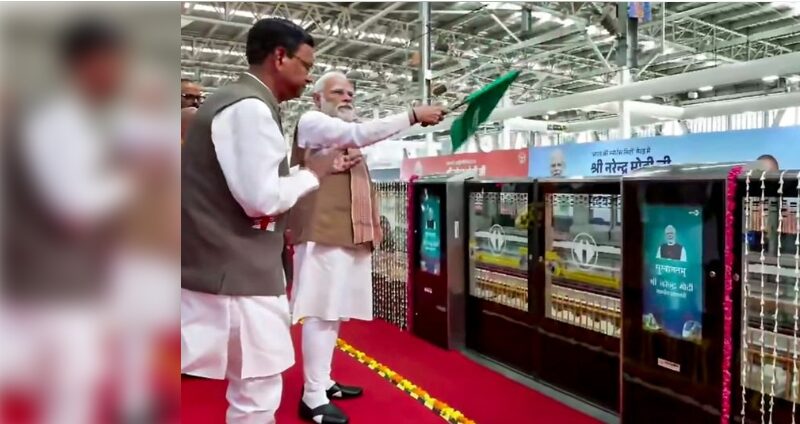
Meerut (Gurpreet Singh): In a landmark event for India’s urban infrastructure, Prime Minister Narendra Modi officially dedicated the entire 82 km Delhi-Meerut Namo Bharat (RRTS) corridor to the nation on Sunday, February 22. Flagging off the final sections from Meerut’s Shatabdi Nagar station, the Prime Minister signaled the completion of a project designed to revolutionize travel between the national capital and its neighboring industrial hub.
Accompanied by Chief Minister Yogi Adityanath, the Prime Minister undertook a ride on the new metro system, inspecting the high-speed infrastructure that now links Sarai Kale Khan in Delhi directly to Modipuram in Meerut. The total package of development projects inaugurated during the visit is valued at approximately ₹12,930 crore, reinforcing the government’s commitment to modernizing the National Capital Region (NCR).
Namo Bharat: India’s Fastest Regional Transit
The Namo Bharat train, which operates at a design speed of 180 kmph, is the first system of its kind in India. The newly commissioned sections include a 5 km stretch in Delhi (Sarai Kale Khan to New Ashok Nagar) and a 21 km stretch in Uttar Pradesh (Meerut South to Modipuram).
The origin point at Sarai Kale Khan is now a premier multi-modal hub, integrating the RRTS with the Hazrat Nizamuddin railway station, the Delhi Metro Pink Line, and the ISBT. This network ensures that major centers like Sahibabad, Ghaziabad, and Modinagar are connected with unparalleled speed, aiming to drastically reduce the carbon footprint by moving thousands of commuters off the congested Delhi-Meerut Expressway.
Meerut Metro: A First-of-its-Kind Integration
In a unique engineering feat, the Prime Minister also inaugurated the Meerut Metro, which shares the same physical infrastructure as the Namo Bharat train.
- Record Speed: Operating at a maximum speed of 120 kmph, it is now officially India’s fastest metro system.
- Rapid Transit: The metro will cover its entire stretch in just 30 minutes, providing a swift intra-city solution that complements the inter-city RRTS.
- Unified Mobility: This integration of regional and local transit on the same tracks is a first for the country, setting a new national benchmark for efficient urban planning.
Vision for Sustainable Urban Growth
Addressing a massive public gathering in Mohiuddinpur following the inauguration, Prime Minister Modi emphasized that these projects are not just about transport, but about improving the “ease of living” for the common citizen. He noted that the seamless, high-speed connectivity would foster industrial growth and create new economic opportunities along the corridor. The project is expected to significantly ease traffic congestion and contribute to a cleaner environment through the reduction of vehicular emissions, aligning with India’s broader sustainability goals.
