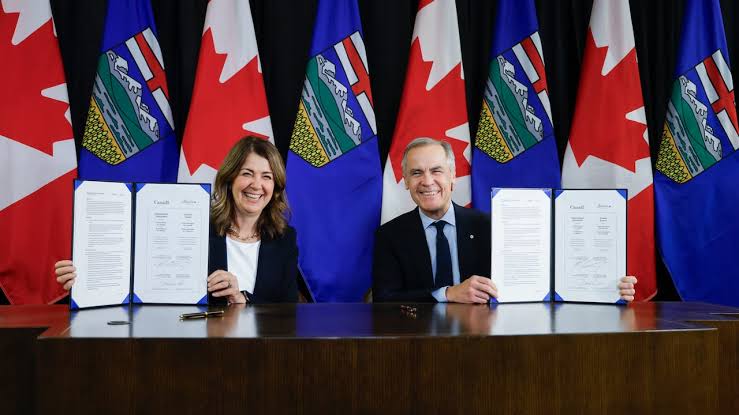
Toronto (Rajeev Sharma)— A major energy agreement between Ottawa and Alberta has shaken Canada’s political landscape, after Prime Minister Mark Carney and Alberta’s premier reached an understanding to work toward a new oil pipeline to the Pacific Coast.
The memorandum of understanding outlines plans to diversify Canada’s oil exports beyond the United States and proposes easing an existing oil tanker ban along sections of British Columbia’s coastline if the project advances. The development immediately stirred internal turmoil in Carney’s cabinet.
One of the strongest reactions came from inside the government itself. A senior cabinet minister resigned from his post in protest, warning that the proposed pipeline could cut through the Great Bear Rainforest and heighten the danger of coastal tanker spills. The minister, a well-known environmentalist, said he could not support the direction the government had taken, though he would remain in Parliament as a Liberal MP. Carney, responding to the resignation, said he respected the decision and appreciated his continued role as a lawmaker.
Carney has repeatedly argued that Canada must reduce its economic dependence on the U.S., especially as American tariffs have begun to chill investor confidence. He noted that more than 95 percent of Canada’s energy exports currently flow south of the border, a reliance he now sees as a strategic weakness.
Alberta Premier Danielle Smith praised the agreement, saying it could eventually allow the province to ship more than one million barrels of oil per day to Asian markets. She said expanding export routes would ensure Canada is not tied to a single customer for its most valuable resource.
Carney echoed that message, saying the framework was only the beginning of what will be a long and difficult process. He added that the project ultimately depends on private sector interest — without a corporate proponent, a pipeline cannot move forward.
The agreement requires Alberta and Ottawa to work closely with British Columbia, where opposition to oil tankers remains strong. B.C. Premier David Eby has already raised concerns, warning that any rollback of the tanker ban could threaten existing coastal development projects and undermine longstanding agreements with First Nations.
Coastal First Nations leaders also dismissed the proposal, saying they have no interest in participating in a project they believe could endanger their communities, waters and cultural heritage.
The pipeline proposal has revived memories of past disputes. In 2016, the federal government had to buy and complete construction on a contentious Alberta-to-B.C. pipeline due to protests and legal challenges. Another project — Northern Gateway — was rejected entirely because it would have passed through the Great Bear Rainforest.
Northern Alberta remains one of the world’s major oil reserves, with an estimated 164 billion barrels of proven resources, making the debate over expansion both politically charged and economically significant.
The new agreement also ties the pipeline to a proposed carbon-capture initiative, with the government saying both projects must advance simultaneously. Alberta and Ottawa have committed to working with companies to finalize new emissions-reduction plans by April 1, targeting rollout in 2027.