

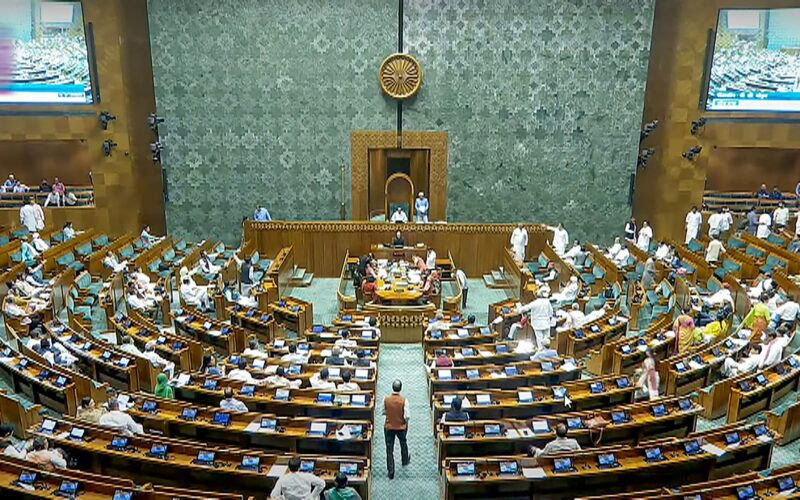
New Delhi (Gurpreet Singh): Parliament is set to reconvene next week, with the Lok Sabha scheduled to meet on November 30 and the Rajya Sabha on December 2, amid speculation that the Narendra Modi government could bring back legislation linked to delimitation and 33% women’s reservation.
Union Parliamentary Affairs Minister Kiren Rijiju announced on Thursday that the government had requested Lok Sabha Speaker Om Birla and Rajya Sabha Chairman CP Radhakrishnan to reconvene the two Houses to transact essential government business. The sittings may conclude on December 3, depending on the requirements of parliamentary business.
While the government has not officially confirmed the legislative agenda, the proposed sittings have fuelled expectations of another attempt to push through the delimitation and women’s quota legislation, which failed to secure the required numbers during an earlier special sitting in April.
Parliament Sitting Schedule: When Will Lok Sabha and Rajya Sabha Meet?
According to Rijiju, the government has requested the two presiding officers to reconvene the Houses on separate dates.
- Lok Sabha: November 30, Monday
- Rajya Sabha: December 2, Wednesday
- Expected conclusion: December 3, subject to parliamentary business
In his announcement, Rijiju said the government wanted the Houses to meet to transact essential government business.
The proposed sittings will be a continuation of the Monsoon Session, which was adjourned sine die on August 13 but had not been formally prorogued. This has allowed the government to seek the resumption of the existing session rather than convening an entirely new one.
The development comes after Parliament remained unprorogued for more than 100 days, drawing attention to the possibility of an early reconvening.
Will Government Bring Delimitation and Women’s Reservation Bills?
The upcoming sittings come amid speculation that the Centre could introduce revised versions of the delimitation legislation and the Constitution Amendment Bill linked to 33% reservation for women in the Lok Sabha and state legislative assemblies.
According to reports, the government is considering a revised proposal that could increase the strength of the Lok Sabha by 50% over the existing representation of every state.
Under the reported proposal, the increase would apply to the current number of seats allocated to individual states, potentially taking the Lok Sabha’s strength beyond its present 543 members.
However, the government has not officially confirmed the details of the proposed legislation or whether these Bills will feature in the upcoming sittings.
Sources cited in media reports have also indicated that Prime Minister Narendra Modi is expected to chair a special Cabinet meeting ahead of the parliamentary proceedings, where the revised proposals could be discussed.
Why Did the Women’s Reservation and Delimitation Bills Fail in April?
The government had attempted to push the legislation during a special parliamentary sitting in April 2026. However, the Constitution (131st Amendment) Bill, 2026, failed to secure the required two-thirds majority in the Lok Sabha.
The Bill was linked to the implementation of 33% reservation for women in the Lok Sabha and state legislative assemblies, with the proposed delimitation exercise forming a key part of the legislative framework.
The failure to secure the necessary votes stalled the government’s attempt to advance the proposed changes.
The upcoming parliamentary sittings could provide another opportunity to negotiate support for the legislation, particularly among regional parties concerned about the impact of delimitation on their states’ representation.
Why Are Southern States Concerned About Delimitation?
Delimitation involves redrawing electoral constituencies and adjusting the allocation of legislative seats based on population-related considerations.
Under Article 82 of the Constitution, the allocation of Lok Sabha seats among states is protected from readjustment until the relevant figures of the first Census conducted after 2026 are published.
This has made the proposed delimitation exercise particularly significant for states with different population growth patterns.
Several southern states have expressed concerns that a delimitation exercise based on population figures could disadvantage them because their population growth has been relatively lower than that of several northern states.
The reported proposal to increase the existing seat allocation of every state by 50% could provide a possible middle ground by expanding representation while seeking to address concerns over the relative share of seats.
Tamil Nadu’s ruling DMK is among the parties whose support could become important in the negotiations. Reports suggest that the proposed increase in the state’s existing 39 Lok Sabha seats could be a factor in discussions.
With the government yet to officially disclose the revised legislative proposals, the question of how delimitation will affect the political representation of different states remains central to the debate.
