

Ontario (Rajeev Sharma): Residents of Kashechewan First Nation continue to struggle as a worsening water emergency shows no clear sign of resolution, forcing families to ration bottled water and prepare for large-scale evacuations.
With tap water no longer safe to use, households are being provided with just one case of bottled water per day — a supply many say is far from sufficient. For families living in overcrowded homes, the shortage has become especially difficult.
Fifteen-year-old Keisha Paulmartin, a resident of the community, said the limited water supply does not meet daily needs. Many homes shelter multiple families and large numbers of children, making it hard to stretch the small allocation for drinking, cooking, and hygiene. “We’re expected to make it work, but often it’s not enough,” she said.
The situation escalated on January 4, when Chief Hosea Wesley declared a local state of emergency after critical failures at both the water treatment and wastewater facilities. Earlier in December, mechanical breakdowns prevented proper chemical treatment of drinking water. Soon after, the sewage system began malfunctioning as well, raising further health concerns.
Community members describe the conditions as deeply distressing. Sinclair Williams, who also lives in Kashechewan, said access to clean water — something most Canadians rarely think about — has become a daily struggle. “No one should have to live like this,” he said, pointing out that basic necessities are no longer guaranteed.
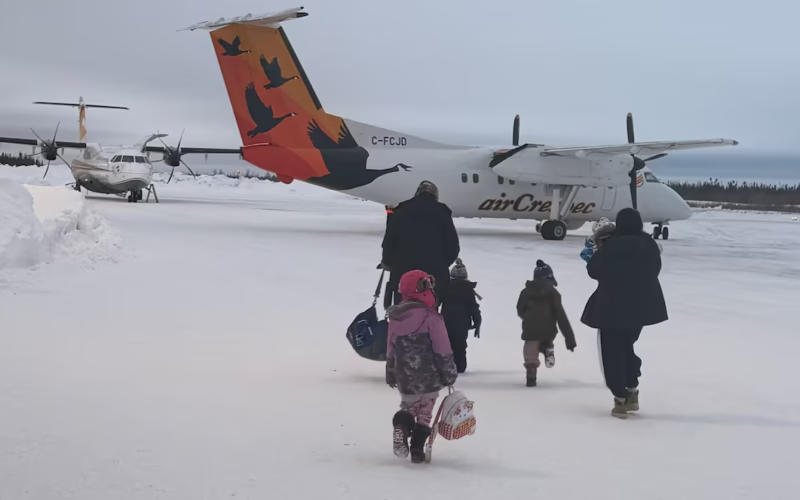
As conditions worsened, evacuations began. On January 7, around 35 of the most vulnerable residents were flown to Timmins, Ontario. Additional charter flights followed the next day, transporting evacuees to Kapuskasing, where facilities are in place to accommodate more than 200 people.
Local leadership is now working alongside federal and provincial authorities to arrange a complete evacuation of the community’s approximately 2,300 residents. The task is complex, as Kashechewan — located along the James Bay coast — has no permanent road access, making air travel the only evacuation option. Poor weather conditions have already delayed some flights, further adding to the uncertainty.
For many residents, evacuation is a familiar — yet disruptive — experience. The community sits on a flood plain near the Albany River and faces seasonal flooding almost every spring.
Paulmartin said evacuations have been part of her life since early childhood. Missing holidays, leaving home, and living temporarily in unfamiliar cities have become routine. “It’s kind of normal for us now,” she said, though she admitted the disruption never gets easier.
Petersen Spence, who grew up in Kashechewan and relocated to Timmins three years ago, recalled spending weeks in hotel rooms during past evacuations. Limited food choices, isolation, and lack of school support made those periods especially challenging. He said those experiences affected his education and forced him to become more independent at a young age.
Both Paulmartin and Spence are members of the community’s Youth Leadership Group and have been attending meetings about the current crisis. According to Spence, leaders have outlined plans to relocate most families to Niagara Falls, while residents with medical or special needs may be sent to Kingston, where accommodations with kitchen facilities are available.
Despite the community’s long history with evacuations, many say this crisis feels different. Unlike seasonal flooding, there is no clear timeline for when water systems will be fully restored.
Former resident Feather Metatawabin, now living in Timmins, said friends and relatives still in Kashechewan are anxious about what lies ahead. She shared concerns about families with children and special needs, recalling previous evacuations where multiple people were confined to small hotel rooms for weeks at a time.
Meanwhile, repair efforts are underway. Technical crews have been deployed to address failures at the water treatment plant. A key pump has already been replaced, and additional equipment is being brought in to complete the repairs.
Until a permanent solution is in place, residents of Kashechewan remain caught between limited resources, repeated displacement, and an uncertain future — a reality many say no community should be forced to endure.
