

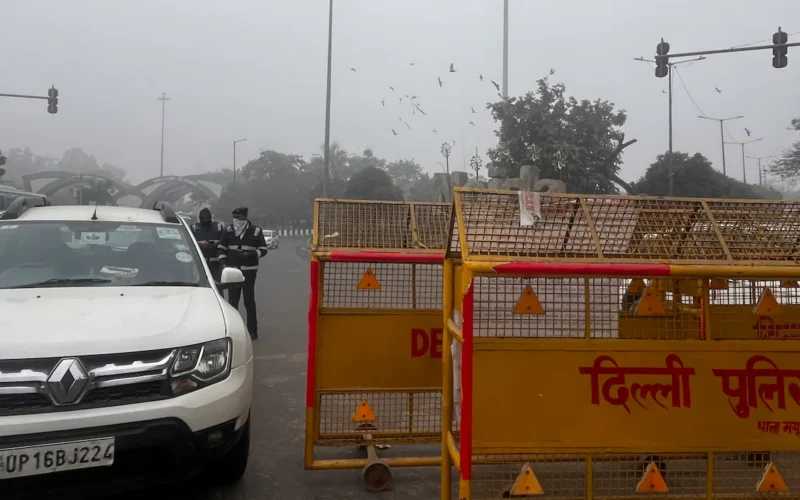
New Delhi (Rajeev Sharma): Delhi’s entry points saw heightened enforcement on Thursday morning as dense smog blanketed the region and air quality slipped to dangerous levels. At the DND Flyway near the Chilla border, visibility dropped sharply, with pollution readings touching the upper end of the “hazardous” scale. In response, authorities activated strict checks under the highest stage of the Graded Response Action Plan (GRAP).
Teams from the Delhi Transport Department and Traffic Police were deployed along border crossings to screen vehicles entering the capital. Officials said privately owned and commercial vehicles registered outside Delhi that do not meet BS-VI emission standards are being stopped outright. Drivers are being given the option of paying a penalty of up to ₹20,000 or turning back.
Barricades were placed along approach roads to slow traffic and allow detailed inspections. Officers on duty said vehicles that appeared old or lacked the BS-VI identification sticker were pulled aside for verification. Diesel vehicles older than 10 years and petrol vehicles beyond 15 years were also barred if they failed to comply with emission rules or lacked a valid Pollution Under Control (PUC) certificate.
Some commuters voiced anger at the sudden clampdown. A driver from Faridabad, whose older car was stopped at the border, said the measures felt one-sided. “Pollution is a larger issue, but ordinary motorists are being penalised. There needs to be equal scrutiny of all vehicles, including government fleets,” he remarked.
Enforcement officials explained that technology is being used to speed up checks. Portable systems allow officers to instantly access vehicle registration data, emission classification and PUC status, reducing the scope for manual errors.
Data from pollution studies show that transport remains a major contributor to Delhi-NCR’s winter air crisis. A significant share of the region’s vehicles are older models that release far higher levels of harmful pollutants than newer BS-VI vehicles, worsening PM2.5 concentrations during colder months.
While authorities insist the curbs are necessary to prevent further deterioration of air quality, environmental experts caution that short-term restrictions must be paired with long-term solutions. They point to the need for faster vehicle scrappage, stronger public transport networks and better monitoring systems to address pollution that moves across state borders.
For now, officials say strict checks will continue at all major entry points as long as air quality remains critical, urging commuters to plan their travel accordingly and comply with emission norms.
