

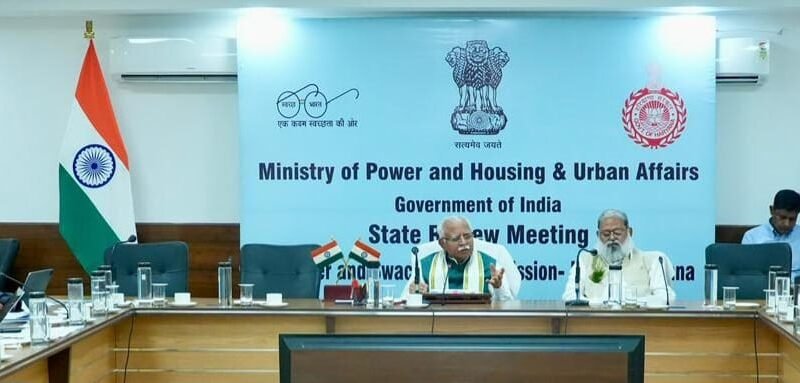
Chandigarh (Balwinder Singh): Union Power Minister Manohar Lal and Haryana Energy Minister Anil Vij chaired a joint performance review in Chandigarh on Tuesday to fast-track modern infrastructure upgrades and evaluate long-term load forecasts. Union authorities directed state distribution companies to adopt immediate technological interventions to balance escalating peak demands while systematically lowering commercial margins and technical transmissions losses. Central executives emphasized that expanding reliable, real-time grid intelligence serves as a critical economic baseline for corporate stability and public sector efficiency.
The infrastructure assessment highlighted a substantial transition in operational efficiency, noting that the province’s aggregate technical and commercial distribution losses dropped from approximately 34 percent recorded in the 2013-14 fiscal cycle. To secure further financial recoveries, the power ministry sanctioned a phased deployment model for prepaid and smart metering across the regional network. The initial modernization phase mandates immediate smart installations across public sector buildings, government administrative offices, and institutional employee residences before scaling the infrastructure to commercial consumers carrying loads exceeding 10 kilowatts. Regional planners noted that the inbound smart units feature multi-directional architecture capable of seamless integration with domestic renewable connections.
According to baseline capacity metrics shared during the assembly, Haryana maintains an aggregate contracted power capacity of 16,552 megawatts, placing the state’s available reserves above the current seasonal peak demand projection of 16,454 megawatts. The state’s current energy matrix leverages a baseline generation mix consisting of 9,929.92 megawatts secured from thermal, gas, and nuclear generation facilities, alongside ,622.58 megawatts supplied through mixed renewable assets including hydroelectric units, wind farms, biomass plants, and grid-scale solar parks. With long-range load modeling projecting regional peak requirements to reach 19,481 megawatts by the 2029-30 fiscal year, officials confirmed the initiation of advanced procurement strategies to cover the structural gap.
On rural electrification vectors, the ministry reviewed the progress of the ‘Mhara Gaon-Jagmag Gaon’ initiative, confirming that 6,117 regional villages receive continuous round-the-clock power supplies. Simultaneously, to drive decentralized clean energy generation, the state set an operational target to deploy 220,000 residential rooftop solar installations under the PM-Surya Ghar Muft Bijli Yojana during the current annual cycle, with approximately 86,000 systems successfully connected to the local grid. Senior administrative officials present at the session included Haryana Power Commissioner Ashima Brar, along with the Managing Directors of both North and South Haryana Electricity Distribution Corporations, Bikram Singh and Dr. Aditya Dahiya.
