

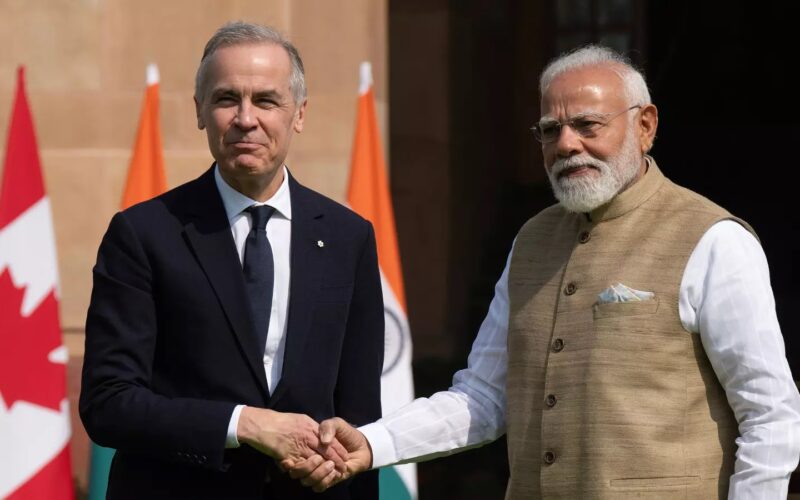
New Delhi (Rajeev Sharma): India and Canada on Monday outlined a sweeping blueprint to elevate their partnership, sealing a multi-billion-dollar uranium supply agreement and committing to expand annual trade to $50 billion by the end of the decade.
Prime Minister Narendra Modi and Canadian Prime Minister Mark Carney held extensive discussions in New Delhi, describing the outcome as the start of a renewed and forward-looking chapter in bilateral relations.
Uranium Deal to Power Civil Nuclear Expansion
A centrepiece of the talks was a $2.6 billion arrangement under which Canada will supply uranium to fuel India’s civilian nuclear reactors. The agreement is expected to strengthen India’s clean energy capacity while reinforcing Canada’s position as a reliable energy partner.
Both countries also pledged cooperation in emerging nuclear technologies, including small modular reactors and advanced reactor systems, signalling long-term collaboration in the atomic energy sector.
Critical Minerals and Clean Energy Collaboration
The leaders signed a memorandum focused on critical minerals, aimed at securing supply chains essential for renewable energy, electric vehicles and advanced manufacturing. With Canada holding substantial reserves of rare earths and other strategic resources, officials said the partnership would reduce vulnerabilities in global mineral supply networks.
In addition to conventional hydrocarbons, the two sides committed to scaling up cooperation in renewable energy, hydrogen fuel, and energy storage solutions. Carney emphasised that the strategic energy partnership carries significant potential to expand two-way trade while supporting climate goals.
Economic Pact on Fast Track
A key outcome of the summit was the decision to accelerate negotiations on a Comprehensive Economic Partnership Agreement (CEPA). The leaders expressed confidence that finalising the pact would boost investment flows and generate employment in both nations.
Current bilateral trade stands at roughly $13 billion annually. By setting a $50 billion target for 2030, the two governments signalled an intention to significantly broaden commercial engagement across sectors.
Modi highlighted the scale of Canadian pension fund investments in India—estimated at $100 billion—as evidence of sustained economic confidence.
Defence and Strategic Dialogue
Beyond economics, New Delhi and Ottawa agreed to institutionalise an India-Canada defence dialogue. Areas identified for deeper engagement include defence industry cooperation, maritime security awareness and expanded military exchanges.
Officials described the move as a reflection of growing mutual trust and strategic maturity between the two democracies.
Education and Technology Ties Deepen
The talks also produced commitments to strengthen collaboration in artificial intelligence, healthcare, agriculture and innovation. Canadian universities are expected to establish campuses in India, broadening academic exchange and research partnerships.
Rebuilding After Diplomatic Strain
The renewed engagement follows a turbulent period in bilateral ties. Relations deteriorated in 2023 after allegations made by then Prime Minister Justin Trudeau concerning the killing of Khalistani separatist Hardeep Singh Nijjar. India rejected the accusations, and the standoff led to diplomatic expulsions on both sides.
Carney’s rise to office marked the beginning of efforts to stabilise relations. Diplomatic representation has since been restored, and high-level exchanges have resumed, including meetings on the sidelines of the G7 summit in Canada last year.
Shared Positions on Global Issues
During their discussions, Modi and Carney also addressed pressing global challenges. They agreed that terrorism and extremism remain shared concerns requiring coordinated international action. The two leaders reviewed the evolving security landscape in West Asia, with India reiterating its call for dialogue and diplomacy as the preferred path to resolving conflicts.
As the meetings concluded, both governments projected optimism that the agreements signed this week would anchor a durable partnership—one aimed at strengthening economic resilience, enhancing clean energy cooperation and reinforcing democratic values in an increasingly uncertain global environment.
