

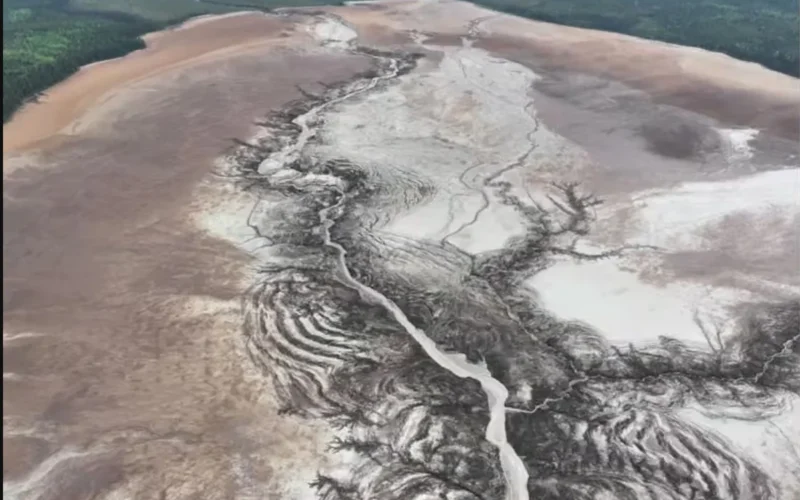
Quebec (Rajeev Sharma): Residents of the Cree community of Waswanipi in northern Quebec are searching for answers after a nearby lake abruptly drained last spring, leaving behind mudflats, dead fish and lingering questions about whether human activity played a role.
Manoel Dixon, 26, was at his family’s hunting camp in May when his father received a puzzling Facebook message from a fellow hunter: “Lake Rouge is gone.” At first, the family struggled to understand what that meant. Lake Rouge, known for its clear water, trout and sandy shores, covered roughly three square kilometres and had long been a fixture of the area.
The next day, they walked along a logging road and saw the damage for themselves. The lake’s water had completely disappeared, replaced by exposed mud where birds circled overhead. A wide scar of sediment stretching northeast showed where the water had rushed nearly 10 kilometres into a larger lake.
“I was devastated,” said Waswanipi Chief Irene Neeposh, who called an emergency meeting despite uncertainty over which authorities could respond to such an event. “Nobody knows what to do in this type of situation.”
Scientists identify the phenomenon as an outburst flood — a sudden and catastrophic drainage of a lake. However, such events have typically been associated with glacial lakes or dam failures. Several international experts told sources they had never encountered an outburst flood from a natural, non-glacial lake like Lake Rouge.
What makes the case even more unusual is that the lake did not drain through its normal outlet but instead carved a new exit point through its shoreline. Diana Vieira, a scientist with the European Commission’s Joint Research Centre, described the event as “absolutely amazing” from a scientific perspective.
Geology played a role. Lake Rouge sat at a higher elevation, with soft banks and a pre-existing weak point. Heavy snowfall followed by a rapid spring thaw may have further stressed the shoreline. But some scientists and Cree elders say broader regional factors cannot be ignored.
Northern Quebec has experienced extensive logging for decades, and two major wildfire seasons in the past six years — including a massive 2023 blaze that burned an area comparable in size to mainland Denmark. A report by the Quebec Cree forestry department concluded that repeated fires stripped vegetation around waterways feeding Lake Rouge, weakening the shoreline where it eventually failed.
“When forests were intact, snow would melt slowly over months,” said Paul Dixon, a local elder and relative of Manoel Dixon. “Now the same amount melts in about a month. It’s like putting ice in a microwave.”
Experts explain that forests typically absorb and slow runoff from rain and snowmelt. Without tree cover, more water enters the soil and groundwater system, oversaturating lake and river banks and reducing their stability.
“Each time soil becomes saturated, it loses strength,” said Younes Alila, a hydrologist at the University of British Columbia. “Eventually, something gives — often along lake or river banks.”
Wildfires can also make soil temporarily water-repellent, increasing runoff, while logging practices such as soil scarification disturb roots and ground structure. Environmental groups visiting Lake Rouge after the event described landscapes resembling open fields rather than forests.
The Quebec government has concluded the lake’s disappearance was natural and has not launched a detailed investigation. It has cited older research suggesting that watershed disturbances affecting less than half of forest cover pose minimal risk to waterways. Some scientists, however, argue that climate change, wildfire frequency and industrial land use are altering hydrological systems faster than past models predicted.
While rare, similar incidents have occurred. In 1974, a small lake about 200 kilometres away drained in under three hours after a sandy ridge was disturbed. Researchers say Canada’s relatively young post-glacial landscape makes such sudden changes more plausible.
For residents of Waswanipi, the loss of Lake Rouge is more than a scientific anomaly. Elders say riverbank collapses and mudslides have become increasingly common in the region, adding to fears that other lakes could face the same fate.
“I need to know if there are other lakes at risk,” Chief Neeposh said. “People need to be warned.”
As researchers debate whether Lake Rouge’s collapse was inevitable or accelerated by human activity, the community is left grappling with a sense that the land they know is changing in unpredictable and unsettling ways.
