

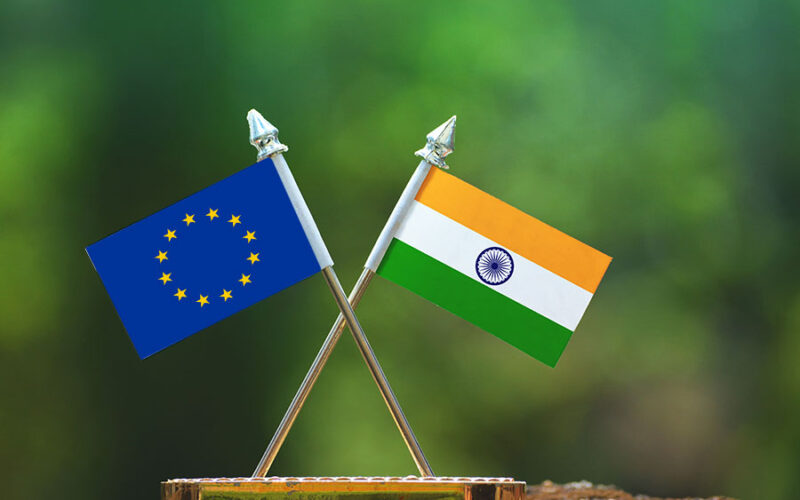
New Delhi (Rajeev Sharma): The newly finalized EU-India Free Trade Agreement (FTA) is being celebrated as a historic “win-win” pact that promises to reshape global trade, technology, and supply chain security. Speaking in New Delhi on Sunday, February 22, Alexander Pröll, Austria’s State Secretary in the Federal Chancellery, described the agreement as the “mother of all deals,” highlighting its potential to benefit nearly 200 crore (2 billion) people and create one of the world’s largest free trade zones.
The FTA, which concluded negotiations on January 27, 2026, arrives at a strategic moment as both economies seek to deepen ties amid shifting global trade dynamics. Pröll emphasized that the pact is not just about commerce but about fostering a human-centered approach to the next era of innovation.
Economic Impact and Tariff Reductions
The agreement provides unprecedented market access, significantly lowering the barriers to entry for goods and services:
- India’s Gains: The EU will eliminate or reduce tariffs on 99.5% of Indian exports by trade value. This is expected to provide a massive boost to labor-intensive sectors like textiles, leather, gems, and jewelry, which will see duties drop to zero immediately upon implementation.
- EU’s Gains: India has committed to reducing or removing tariffs on 96.6% of EU exports by value. Notably, high duties on European cars (previously up to 110%) will be slashed to as low as 10% over a phased period, while tariffs on premium items like wines and olive oil will also see sharp declines.
Focus on Human-Centered AI and Resilient Supply Chains
A unique feature of this “future-ready” agreement is the heavy emphasis on Artificial Intelligence (AI) and digital governance. Pröll, who attended the India AI Impact Summit 2026 alongside Prime Minister Narendra Modi, described AI as “the next step after digitalization.”
- Democratic Innovation: Pröll advocated for an AI framework that “serves the people,” emphasizing that India and the EU can lead the world in developing ethical, human-centric AI that protects democratic values.
- Strategic Interdependence: Regarding global supply chains, the State Secretary argued for building mutual dependencies rather than isolation. He noted that the FTA is a critical tool for creating closer sovereignty through shared economic strengths.
Next Steps and Implementation
While the technical negotiations are complete, the deal is currently undergoing final legal vetting and “scrubbing.”
- Ratification: The pact requires formal approval from the Council of the European Union, consent from the European Parliament, and ratification by the Indian government.
- Timeline: Commerce Minister Piyush Goyal has indicated that the agreement is on a fast track and is expected to come into force within the 2026 calendar year.
