Jerusalem (Rajeev Sharma): In a speech marked by repeated applause and symbolic gestures, Prime Minister Narendra Modi on Wednesday addressed the Israeli Parliament, asserting that “no cause can justify the murder of civilians” and reiterating India’s uncompromising stand against terrorism.
Opening his address with “Shalom! Namaste!”, Modi told members of the Knesset that it was a privilege to stand as “the Prime Minister of India and as a representative of one ancient civilisation addressing another.” He conveyed greetings from 1.4 billion Indians and described India-Israel ties as deeply rooted in history, strengthened by democratic values and elevated into a strategic partnership of global relevance.
The House responded with several standing ovations, particularly when Modi offered condolences for victims of the October 7 Hamas attack and reaffirmed India’s “zero tolerance” approach to terrorism. Drawing parallels with the 26/11 Mumbai terror attacks, which also claimed Israeli lives, he said India stands with Israel “firmly, with full conviction, in this moment, and beyond.”
“Terrorism aims to destabilise societies, block development and erode trust,” he said, calling for coordinated and sustained global action against the threat.
Balancing solidarity with a broader regional outlook, the Prime Minister also stressed the importance of lasting peace in West Asia. Referring to the Abraham Accords and evolving regional dynamics, he said hope must endure despite challenges. India, he added, supports initiatives that promise a just and durable peace, including efforts addressing the Palestinian issue.
Modi wove civilisational references into his speech, recalling that Jewish communities have lived in India for over two millennia without facing persecution. He cited the Bene Israel of Maharashtra, the Cochini Jews of Kerala, the Baghdadi Jews of Kolkata and Mumbai, and the Bnei Menashe of the Northeast as examples of enduring cultural ties.
He paid tribute to Indian soldiers who fell in the region during the First World War, especially the cavalry charge at Haifa in 1918, describing it as a shared chapter of sacrifice. Referring to the Holocaust era, he also remembered the Maharaja of Nawanagar in Gujarat, who offered refuge to Polish children, including Jewish children, during World War II.
Highlighting economic and technological cooperation, Modi described India as the fastest-growing major economy and Israel as a global innovation hub. He called for deeper collaboration in trade, defence, agriculture, water management, artificial intelligence, semiconductors and quantum technologies. Negotiations on a comprehensive free trade agreement are progressing, he said, while initiatives such as the India-Middle East-Europe Economic Corridor and the I2U2 framework are opening new opportunities.
He noted that 43 Centres of Excellence established in India with Israeli cooperation have trained over half a million farmers and proposed expanding the network to 100 centres.
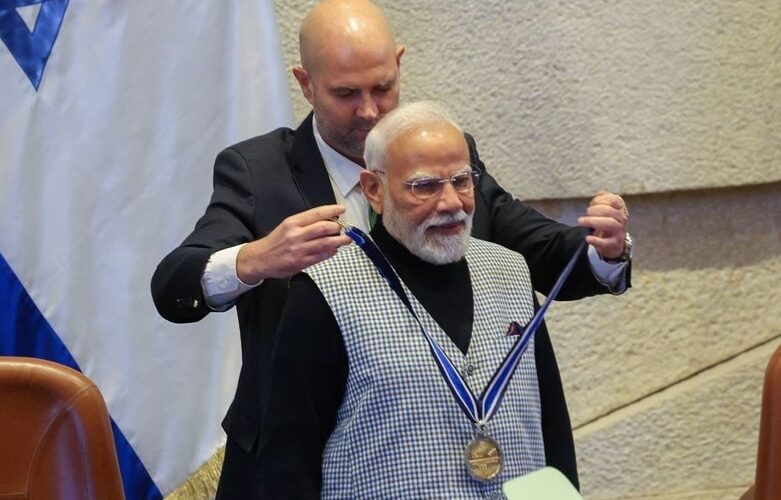
In a significant moment, the Parliament conferred upon Modi the “Speaker of the Knesset Medal,” its highest honour, recognising his role in strengthening strategic relations between India and Israel. He became the first Indian Prime Minister to receive the distinction. In 2018, he had also been awarded the Grand Collar of the State of Palestine, the highest honour granted by Palestine to foreign leaders.
Modi concluded his address with “Am Yisrael Chai” and “Jai Hind,” drawing another ovation from the chamber.
The session, however, began amid political tensions. Opposition members staged a walkout to protest Speaker Amir Ohana’s decision not to invite Supreme Court President Isaac Amit to the special sitting. As opposition lawmakers exited the plenum, former coalition members filled their seats to ensure a full chamber for the address.
Opposition leader Yair Lapid briefly addressed the House before Modi’s speech and clarified that the internal dispute was unrelated to the visiting dignitary. Shortly after the Prime Minister began speaking, opposition members returned to the chamber.
The address ultimately highlighted both the expanding India-Israel partnership and the domestic political undercurrents within Israel that unfolded alongside the diplomatic event.
Modi Addresses Knesset, Condemns Terrorism and Receives Top Parliamentary Honour Amid Political Walkout
 0 Comments