

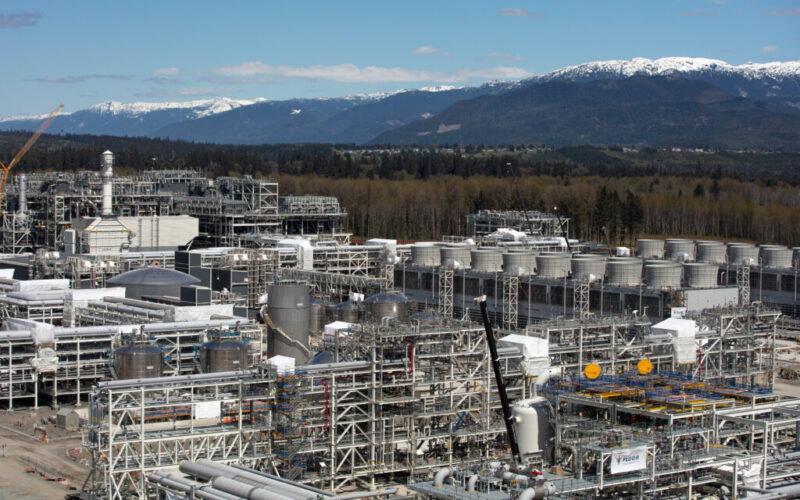
Kitimat, B.C. (Rajeev Sharma)— In a critical move for global energy security, LNG Canada has significantly accelerated its production and export volumes this week as the escalating conflict in West Asia threatens to cripple the world’s liquefied natural gas supply. Data released on Wednesday, March 11, 2026, indicates that the Shell-led facility in Kitimat is operating near its full capacity of 14 million metric tonnes per year, providing a vital alternative for Asian nations currently cut off from traditional Gulf sources.
The urgency comes as QatarEnergy, which normally accounts for approximately 20% of the world’s LNG trade, declared force majeure earlier this month. The ongoing “Operation Epic Fury”—the codename for the U.S.-Israeli military campaign against Iran—has rendered the Strait of Hormuz virtually unnavigable for commercial tankers. With nearly 20 million barrels of oil and a fifth of global gas supplies transiting that narrow corridor daily, the closure has sent spot prices in Northeast Asia and Europe soaring by nearly 70%.
A Strategic Pacific Gateway
According to LSEG tracking data, LNG Canada has already exported five massive cargoes in the first 11 days of March, representing more than half of its total volume from the previous month. A sixth shipment is scheduled to depart the northern British Columbia port on Thursday. These cargoes are primarily destined for Japan, South Korea, and the Philippines—nations that are acutely vulnerable to maritime chokepoints in the Middle East but can be reached from the Canadian West Coast in significantly less time than from the U.S. Gulf Coast.
Industry analysts suggest that the Kitimat terminal is finally hitting its stride after facing several operational hurdles during its initial startup phase last summer. Martin King, a senior analyst with RBN Energy, noted that the facility is currently making a “quick surge” in output to capitalize on the high regional prices and to serve as a stabilizing force in the Indo-Pacific. The project’s direct access to the Pacific Ocean allows it to bypass the increasingly unstable Suez and Panama Canal routes, making it one of the most reliable energy corridors in the current geopolitical climate.
Economic Impact and Domestic Pricing
The ramp-up is also bringing much-needed relief to Western Canadian natural gas producers. Last autumn, domestic spot prices at the Alberta Energy Company (AECO) hub briefly dipped into negative territory as local supply outpaced the available export infrastructure. However, with LNG Canada now drawing down significant volumes, AECO prices have stabilized near $2 per million British thermal units. While this remains a discount compared to the U.S. Henry Hub benchmark, it represents a significant recovery for the Canadian energy sector.
Mike Belenkie, CEO of Advantage Energy, observed that the facility appears to have been running at peak capacity for the last fortnight. He emphasized that the current global crisis highlights the “security dividend” of Canadian energy. As long as the conflict in West Asia continues to obstruct the Strait of Hormuz, the global market’s eyes will remain fixed on Kitimat as a primary buffer against a total energy collapse.
