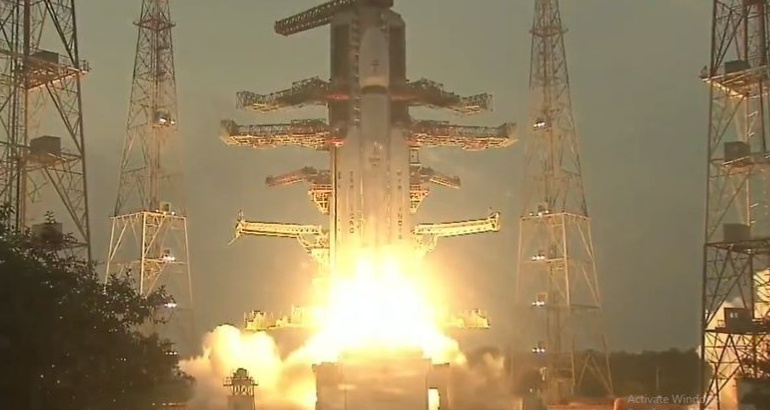
Sriharikota, November 2 — The Indian Space Research Organisation (ISRO) on Sunday successfully launched the Indian Navy’s latest communication satellite, GSAT-7R (CMS-03), from the Satish Dhawan Space Centre in Sriharikota, Andhra Pradesh. The launch was carried out using the LVM3-M5 rocket the same vehicle that powered India’s Chandrayaan-3 mission to the Moon’s south pole.
Weighing nearly 4,400 kilograms, GSAT-7R is India’s heaviest communication satellite so far. Developed entirely with indigenous technology, it will enhance the Navy’s space-based communication and maritime surveillance systems. The satellite was placed in a geosynchronous transfer orbit and is designed to operate for 15 years.
According to ISRO, GSAT-7R is a multi-band satellite equipped with advanced transponders that will ensure uninterrupted voice, data, and video communication across the Indian Ocean Region. It will connect naval ships, submarines, aircraft, and maritime command centres through high-speed, secure communication links, strengthening India’s maritime defense network.
The LVM3 rocket a three-stage launch vehicle includes two solid propellant boosters, a liquid-fuel core stage, and a cryogenic upper stage. For the first time, ISRO successfully carried out reignition of the cryogenic engine, a significant step in improving long-duration missions.
ISRO Chairman Dr. V. Narayanan said the launch was executed perfectly despite challenging weather. “All systems performed as expected, and the satellite was placed accurately into orbit. This is a proud moment for India’s space and defense sectors,” he said.
Mission Director T. Victor Joseph also praised the team’s performance, noting that the successful reignition of the cryogenic engine marked a technological milestone for India’s launch capabilities.
With the GSAT-7R mission, ISRO has once again strengthened India’s self-reliance in space-based defense communication and marked another milestone in its expanding space technology journey.