

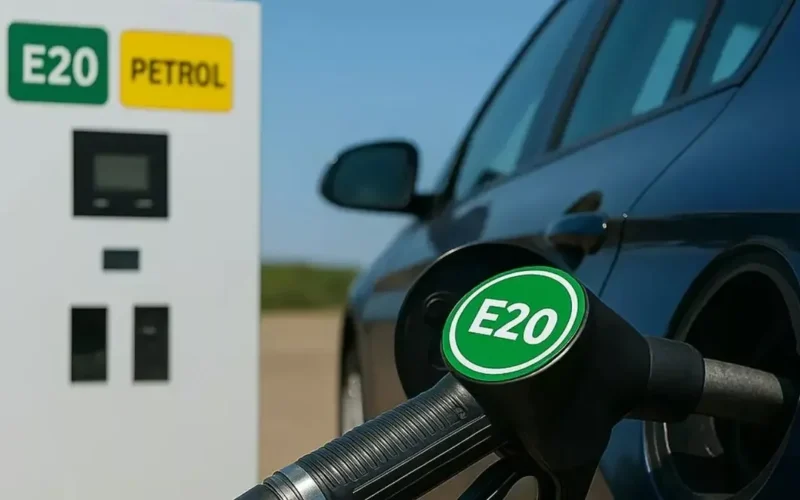
New Delhi (Gurpreet Singh): The Indian government and leading domestic car manufacturers have strongly defended the nationwide implementation of E20 ethanol-blended petrol, confirming that rigorous scientific evaluations show no evidence of the biofuel causing engine damage. The unified reassurance addresses widespread public anxieties and unverified social media claims regarding vehicle durability, particularly for older models. To address these concerns, the Ministries of Petroleum and Natural Gas, Heavy Industries, and Road Transport and Highways coordinated with major industry leaders to clarify that the green energy transition was executed only after extensive laboratory testing and field validation.
Maruti Suzuki, the country’s largest passenger vehicle manufacturer, provided substantial empirical data to support the safety of the transition. The automaker revealed that out of 2.84 crore vehicles serviced across its network during the 2025-26 fiscal year, more than 1.5 crore cars were over three years old and lacked formal E20 certification. Despite millions of uncertified older vehicles operating on the new fuel blend, the company has not recorded a single field report indicating engine corrosion, abnormal mechanical wear, or a premature reduction in component lifespan.
While manufacturers remain confident about long-term engine reliability, they acknowledged a marginal impact on overall fuel efficiency. Because E20 petrol possesses a 3 to 3.5 per cent lower calorific value than the older E10 blend, motorists will experience a minor reduction in mileage, equating to roughly 0.6 kilometres per litre for a standard vehicle delivering 20 kilometres per litre. However, engineering experts emphasized that daily variables like incorrect tyre pressure, aggressive driving habits, delayed maintenance, and frequent braking cause much larger real-world fluctuations in mileage. Furthermore, the slight energy drop is heavily countered by ethanol’s superior octane rating, which provides enhanced anti-knocking characteristics, quicker acceleration, and substantially lower tailpipe emissions.
Echoing these observations, Toyota Kirloskar Motor stated that the introduction of E20 strictly adhered to internationally recognized UNECE certification protocols, describing ethanol as a high-performance, clean-burning fuel used globally for decades. The company also clarified that newly introduced E85 dispensing stations are reserved exclusively for specialized flex-fuel vehicles. Additionally, representatives from Engineers India Limited noted that the blending roadmap conforms entirely to Bureau of Indian Standards mandates and BS-VI emission norms, while Hero MotoCorp confirmed that an extensive analysis of two-wheeler service data revealed no escalation in engine anomalies, reaffirming that the strategic energy shift remains a safe, vital measure to reduce crude oil imports and curb urban pollution.
