

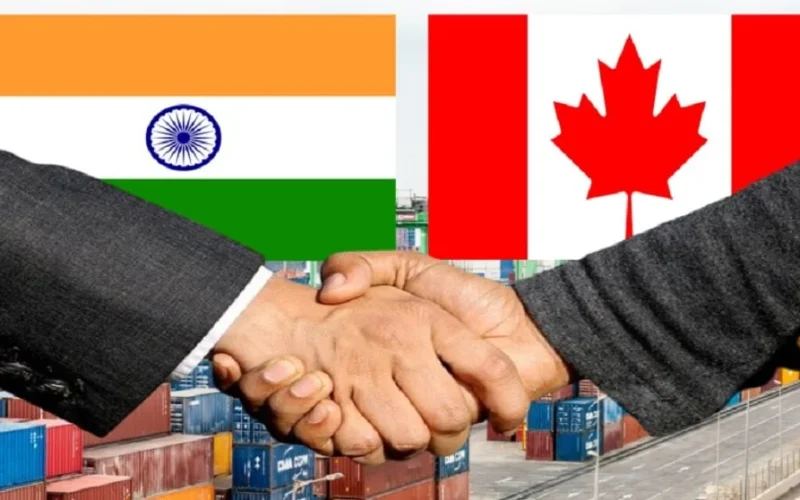
New Delhi/Ottawa (Gurpreet Singh/Rajeev Sharma)— In a move designed to reset and revolutionize economic ties, India and Canada officially launched negotiations for a Comprehensive Economic Partnership Agreement (CEPA) on Monday, March 2, 2026. The Terms of Reference (ToR) for the landmark agreement were signed by Indian Commerce Minister Piyush Goyal and Canadian International Trade Minister Maninder Sidhu at Hyderabad House. The exchange took place in the presence of Prime Minister Narendra Modi and Canadian Prime Minister Mark Carney, marking a significant milestone in the first official visit by the Canadian leader to the Indian capital.
During the high-profile ceremony, Prime Minister Modi set an ambitious target to scale bilateral trade to US$50 billion by the year 2030. He emphasized that the priority for both nations is to unlock the full potential of their economic cooperation through the swift finalization of the CEPA. Prime Minister Carney echoed this sentiment, describing the move as the expansion of a “valued partnership with new ambition, focus, and foresight.” He noted that the two confident countries are now charting a shared course for a prosperous future, moving beyond previous diplomatic hurdles to focus on mutual economic security.
The newly signed Terms of Reference will serve as a structural guide for the upcoming negotiations, outlining the format, frequency, and specific approach to the talks. The agreement is expected to be comprehensive, covering trade in goods, services, and other mutually agreed policy areas. With Canada representing a market of over 41 million people and a GDP of US$2.34 trillion at purchasing power parity, the potential for growth is immense. Currently, bilateral trade stands at a modest US$8.66 billion, with India exporting pharmaceuticals, steel, and electronics, while importing pulses, coal, and crude oil from Canada.
Beyond the movement of goods, the CEPA is expected to provide a significant boost to the services sector, particularly in telecommunications, computer information, and business services. The agreement also recognizes the profound “One Family” connection between the two nations, underpinned by a vibrant Indian community in Canada and more than 425,000 Indian students pursuing education there. As both leaders look toward 2030, the signing of the ToR signals a pragmatic and determined “reboot” of the India-Canada relationship, centered on trade, innovation, and people-to-people synergy.
