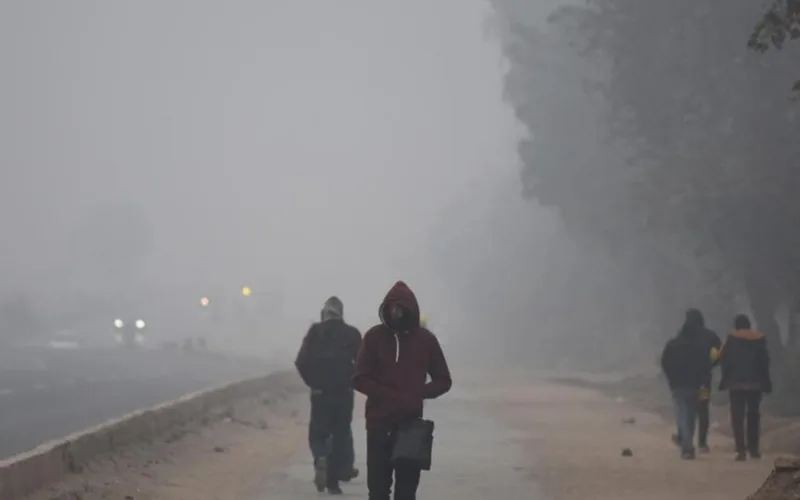
New Delhi, December 1, 2025: Large parts of central, northwest and northeast India are likely to face a colder-than-normal winter, with higher cold wave days expected between December and February, according to a new forecast by the India Meteorological Department (IMD). Officials said the polar vortex will drive temperatures further down, increasing the intensity of cold conditions across these regions.
Spatial maps released by the IMD show parts of Haryana, Rajasthan, Delhi and Gujarat heading for below-normal temperatures. The department said these regions could witness one to four or more cold wave days above the usual average. Typically, northwest India records around five to six cold wave days during the winter months.
A cold wave is declared when the minimum temperature falls below 90% of the daily temperature values recorded for a given station and stays below 15°C for at least three consecutive days.
The IMD projection indicates normal to below-normal minimum temperatures across most parts of central India, the adjoining peninsular region and northwest India. Above-normal minimum temperatures, however, are expected in remaining parts of the country.
For December, the agency expects normal to below-normal night temperatures in central and northwest India and northern portions of the peninsular region. Day temperatures are likely to be above normal across most regions except parts of central India and adjoining northwest and peninsular areas, where normal to below-normal maximum temperatures are projected.
Rainfall across the country in December is likely to remain within the normal range—between 79% and 121% of the long-period average. Above-normal rainfall is expected in many parts of peninsular India, west-central India, and pockets of east-central and northeast India. The rest of the country is likely to see below-normal rainfall.
IMD officials linked the anticipated dip in temperatures to the modulation of the polar vortex throughout November. The combined effect of the polar vortex and La Niña conditions is expected to intensify cold spells during the next three months.
OP Sreejith, head of IMD’s Climate Monitoring and Prediction Group, said the recent cold wave conditions in Madhya Pradesh were influenced by these two phenomena. He noted that the polar vortex is strengthening again.
The polar vortex is a large zone of low pressure and cold air surrounding the Earth’s poles. It remains present throughout the year but weakens in summer and strengthens in winter.
IMD Director General M. Mohapatra added that fewer western disturbances this winter and the ongoing La Niña phase will contribute to colder conditions. La Niña is expected to continue into the Northern Hemisphere winter, with a transition to ENSO-neutral likely between January and March 2026.
La Niña refers to a cooling of sea surface temperatures in the central and eastern equatorial Pacific and is known for altering atmospheric circulation patterns. It often triggers harsher winters in India.
In November, most parts of the country recorded normal to below-normal minimum temperatures except areas in Northeast and Peninsular India. The month also saw a 42.8% rainfall deficit nationwide, including a 78.1% deficiency in northwest India, 51.3% in central India and 43.6% in the southern peninsula. East and northeast India recorded 8.9% excess rainfall.