

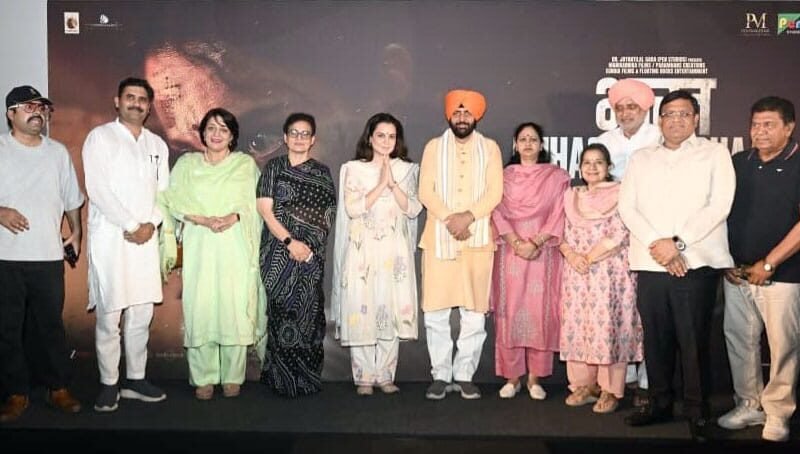
Chandigarh (Balwinder Singh): Haryana Chief Minister Nayab Singh Saini announced that the Hindi film ‘Bharat Bhagya Vidhata’ will be exempt from entertainment tax in the state. Speaking at a special screening of the movie in Chandigarh, Saini praised the project, noting that it highlights the strength and resilience of regular citizens, whom he described as the true architects of India’s destiny and progress toward becoming a developed nation.
The event, attended by several prominent figures including Member of Parliament and actress Kangana Ranaut, served as a platform to honour several public service personnel. Healthcare workers, police officers, and firefighters were recognized for their dedicated service to humanity. Saini highlighted that while public heroes often receive the spotlight, doctors, nurses, security forces, and social workers remain the true backbone of the nation during crises, drawing parallels to the selfless dedication witnessed during the COVID-19 pandemic.
Set against the backdrop of the 26/11 Mumbai terror attacks, the film was commended by the Chief Minister for its sensitive portrayal of courage, duty, and humanity. Saini emphasized the evolution of India’s national security stance under the leadership of Prime Minister Narendra Modi, stating that the country no longer compromises on its sovereignty and actively combats terrorism with decisive actions, citing ‘Operation Sindoor’ as a recent example.
Saini also lauded the film’s representation of women, reinforcing the shifting societal perspective within the state. He remarked that initiatives like ‘Beti Bachao, Beti Padhao’ have significantly boosted female participation across scientific, athletic, military, and academic sectors in Haryana, effectively transforming a state that once faced severe gender ratio challenges. Concluding his address, the Chief Minister reiterated that cinema serves as a vital mirror and guide for society, urging all citizens to collectively contribute toward the vision of a developed India by 2047.
