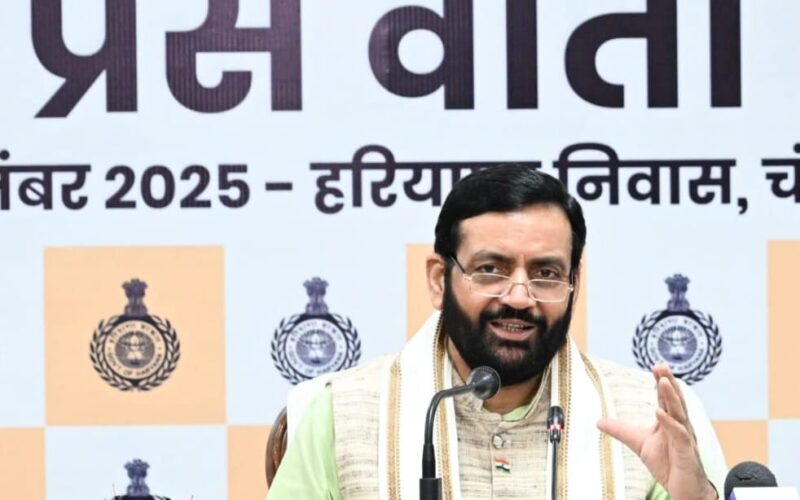
Chandigarh, September 6 — Haryana Chief Minister Nayab Singh Saini on Friday said that the GST reforms announced by Prime Minister Narendra Modi during his Independence Day address have been implemented within a month, proving that “Modi’s guarantee always gets fulfilled.” He added that the reforms would be a milestone in building Atmanirbhar Bharat and would play a key role in advancing the Make in India vision.
Addressing a press conference, Saini said GST has simplified the taxation system, eliminated inter-state trade barriers, and realized the idea of “One Nation, One Tax, One Market.” He called the decisions taken in the 56th GST Council meeting historic, noting that rationalizing tax rates will make daily-use consumer goods cheaper, boost middle-class savings, and increase festive season demand.
According to the reforms, only two standard GST slabs—5% and 18%—will remain, while the 12% and 28% slabs have been removed. Harmful products will continue to attract a higher rate of 40%. Many essential goods have seen tax reductions, with GST on packaged milk and cheese reduced to zero, while ghee, butter, and dry fruits have dropped from 12% to 5%. Everyday food items like roti and parantha are now fully exempt.
In response to Haryana’s request, GST rates on stubble management farm equipment, tractors, irrigation machinery, and bio-fertilizer inputs have been reduced, easing farmers’ costs. Saini thanked Finance Minister Nirmala Sitharaman for considering the state’s concerns. He said the reforms will strengthen agriculture, support food processing industries, and generate rural employment.
The Chief Minister highlighted reductions in renewable energy equipment GST (12% to 5%) to promote clean energy, textile inputs from 12% to 5% to help MSMEs, and sewing machines from 18% to 5% to boost job creation. Essential life-saving drugs now attract zero GST, while health and life insurance premiums have also been exempted. Automobiles, including small cars and motorcycles with limited engine capacity, have seen rates drop from 28% to 18%, making them more affordable for the middle class. Cement GST has also been cut from 28% to 18%, reducing housing and infrastructure costs.
At the same time, taxes on harmful goods like tobacco, pan masala, and sugary or caffeinated drinks have been raised to 40% to discourage consumption.
Saini also highlighted Haryana’s strong GST performance, stating that the state ranked fifth in the country in gross collections for 2024–25. Haryana’s net SGST revenue grew by 110% from ₹18,910 crore in 2018–19 to ₹39,743 crore in 2024–25, with a further 20% growth projected in 2025–26.
The press conference was attended by Principal Secretary to the CM Rajesh Khullar, Excise and Taxation Commissioner Vinay Pratap Singh, Director General of Information, Public Relations and Languages Department K. Makarand Pandurang, and Media Secretary to the CM Praveen Atreya.
GST Reforms Implemented Within a Month, Proof of PM Modi’s Guarantee: Haryana CM Nayab Singh Saini
 0 Comments