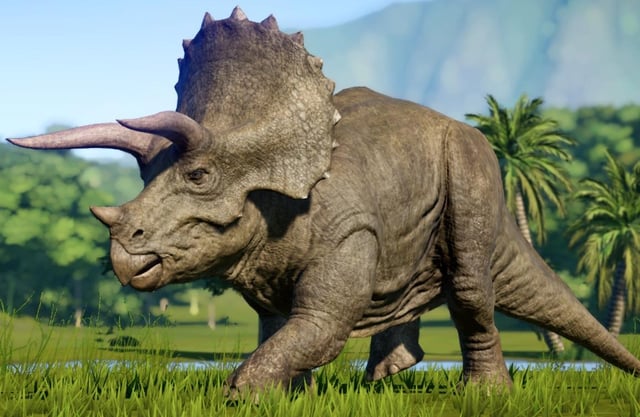
Saharanpur, November 9, 2025: A rare fossil resembling the horn of a Triceratops dinosaur has been discovered along the Sahansara River in Uttar Pradesh’s Saharanpur district, sparking excitement among paleontologists and geologists.
The discovery was made by Mohammad Umar Saif, founder of the Natural History and Conservation Centre. According to Saif, the fossil’s size and shape closely match the nasal horn of a Triceratops, although scientific verification is still awaited. “While we cannot confirm it with complete certainty yet, the morphology strongly resembles Triceratops remains seen in other parts of the world,” he said.
Experts believe the fossil, now turned into sandstone due to mineralisation, could be around 35 to 40 million years old. It was found in the Shivalik foothills — a region already known for yielding prehistoric fossils of elephants and other ancient species.
If confirmed, this would be one of the rare instances of a horned dinosaur fossil discovered in India. Triceratops dinosaurs, which roamed the Earth during the Late Cretaceous period (approximately 66 million years ago), are iconic for their three horns and massive frilled skulls.
Scientists have highlighted the importance of this find, as it could reshape the understanding of dinosaur evolution and migration patterns across ancient landmasses. The fossil’s preservation also underscores the geological significance of the Siwalik range, which has consistently provided key insights into prehistoric life in northern India.
Dr. Saif has shared detailed images of the fossil with the Geological Society of India and other institutions for formal examination. A thorough analysis, including radiometric dating and comparative fossil studies, will determine its exact classification.
Experts have urged authorities to protect the Shivalik-Saharanpur region from illegal excavations and environmental damage, citing its immense paleontological value.