

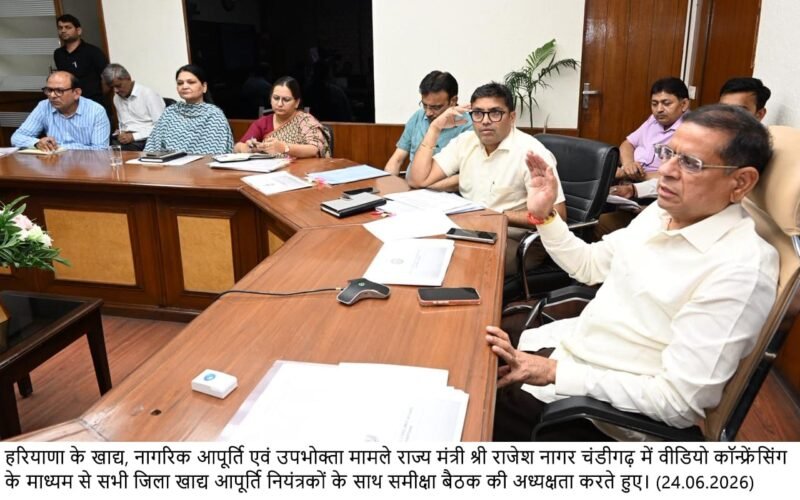
Chandigarh (Balwinder Singh): Haryana Minister of State for Food, Civil Supplies, and Consumer Affairs, Rajesh Nagar, has directed departmental officials to significantly speed up the process of establishing 4,000 new ration depots across the state, in alignment with Chief Minister Nayab Singh Saini’s budget announcement. Presiding over a comprehensive review meeting with all District Food and Supplies Controllers via video conferencing on Wednesday, the Minister emphasized that the public distribution system must remain completely seamless. He ordered that whenever a depot license is suspended or cancelled, details of its attachment to the nearest alternative depot must be proactively communicated to both the headquarters and the general public to spare consumers any unnecessary hardship.
Minister Nagar stated that effectively implementing the central government’s “One Nation-One Ration Card” initiative remains a top priority for his department. To ensure robust execution, he instructed officials to update biometric data from malfunctioning Point of Sale machines with the primary database, while simultaneously integrating modern features like iris scanners and facial recognition technology into these devices. To support local distributors, the Minister ordered that the margin money for ration depot operators must be credited automatically to their bank accounts by the 10th of every month. He further directed the formation of specialized headquarters-level teams to strictly monitor grain stocks, mandating random on-site inspections at least four to five times a month.
During the meeting, senior administrative officials reported that Haryana currently supports 40 lakh families under the Antyodaya Anna Yojana and Below Poverty Line categories, delivering essential monthly rations to 1.57 crore individual beneficiaries. This welfare pool includes 2.86 lakh Antyodaya families and 37.14 lakh BPL families. Under the National Food Security Act, Antyodaya households receive 35 kilograms of wheat free of cost, while BPL families are provided 5 kilograms of free wheat per family member. Additionally, the public distribution system supplies one kilogram of sugar at a highly subsidized rate of ₹13.50, alongside one and two-litre packs of mustard oil distributed well below market prices.
With an eye on continuous system upgrade, Minister Nagar directed officials to thoroughly study the public distribution models of neighboring territories—including Punjab, Himachal Pradesh, Delhi, and Rajasthan—to identify any additional essential commodities provided to consumers there. Commissioner and Secretary of the department, Dr. J. Ganeshan, briefed the Minister that a dedicated digital portal is being developed to fully automate the payment of margin money to depot operators, adding that an allocation of ₹42.90 crore has already been disbursed for April 2026. Addressing food grain storage challenges after state procurement, the Minister recommended drafting a central guarantee-based warehousing policy on the lines of the Food Corporation of India to incentivize private investment and generate local youth employment. Officials also confirmed that an order for 54,000 jute bales has been placed with the Jute Commissioner in Kolkata for the upcoming Kharif marketing season, while physical verification of the state’s 1,401 rice mills is underway with a strict completion deadline of June 30. The high-level review session was attended by Director General Anshaj Singh and Special Secretary Jagdeep Dhanda, among other senior dignitaries.
