

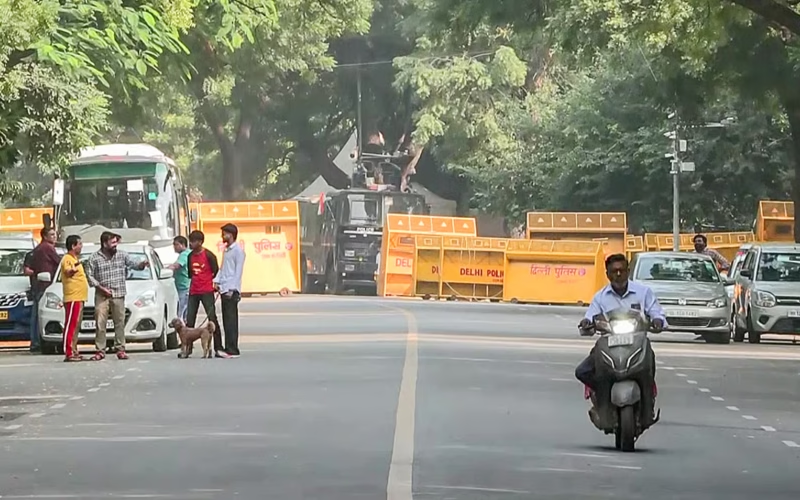
New Delhi (Rajeev Sharma): The national capital has witnessed an extensive security buildup ahead of a planned demonstration by the Cockroach Janata Party (CJP) and student groups at Jantar Mantar. The protesters are demanding the resignation of Chief Election Commissioner Gyanesh Kumar, while authorities have introduced restrictions on public movement, transport services and mobile internet in several areas.
Despite the police refusing permission for the proposed gathering, supporters have reportedly started arriving in Delhi. Officials have deployed thousands of personnel at key locations to prevent unauthorised assemblies and maintain law and order.
The demonstration is centred on demands for accountability in the functioning of the Election Commission. Protesters are seeking Kumar’s resignation and criminal action against him, a halt to the Special Intensive Revision (SIR) of electoral rolls, and the reinstatement of the voter list published in January 2025. They are also calling for an independent investigation and the repeal of the 2023 legislation governing the appointment of election commissioners.
More Than 35,000 Security Personnel Deployed
Delhi Police have imposed prohibitory orders under Section 163 of the Bharatiya Nagarik Suraksha Sanhita (BNSS). Security arrangements include extensive barricading on roads leading to Jantar Mantar, alongside the deployment of police and paramilitary forces.
According to the reported arrangements, more than 35,000 personnel from Delhi Police, the Border Security Force (BSF) and the Central Reserve Police Force (CRPF) have been mobilised. Water cannons and Vajra riot-control vehicles have also been positioned at sensitive locations.
Authorities are keeping a close watch on entry points, transport hubs and areas surrounding the planned demonstration as they prepare for possible gatherings throughout the day.
Mobile Internet Suspended in Selected Areas
Connectivity restrictions have added to the measures being implemented across the capital. Mobile internet services have been suspended in several areas, including a zone extending four kilometres around Janpath and Kartavya Path in the New Delhi district.
The restriction in the specified zone began at 10 pm on Friday and is scheduled to remain in effect for 24 hours.
Officials have also warned that supporters attempting to enter Delhi to participate in the demonstration could face detention. Police have stated that the CJP has not been granted permission to organise protests at any location in the city.
Metro Network Faces Major Disruption
Commuters are also facing restrictions on metro travel. A total of 57 Delhi Metro stations have reportedly been closed from 9 pm on Friday, with services at the affected stations expected to resume once authorities consider the situation normal.
The closures represent a significant disruption for passengers travelling across the capital. The Sarai Kale Khan and New Ashok Nagar stations on the Namo Bharat corridor are also scheduled to remain shut until 10 pm on Saturday.
However, Namo Bharat services between Anand Vihar and Modipuram are expected to operate according to their usual schedule.
Passengers have been advised to check the latest service information before beginning their journeys, particularly if their routes involve stations in areas affected by the restrictions.
Over 224 Trains Cancelled
Railway operations have been hit by additional restrictions, with more than 224 trains reportedly cancelled for Saturday. The affected services include Rajdhani, Shatabdi and Vande Bharat trains, as well as 179 local services.
Under the announced arrangements, trains departing from New Delhi, Hazrat Nizamuddin and Tilak Bridge stations after 2 pm on Friday were cancelled. Services scheduled to arrive at these stations between 4 am and 2 pm on Saturday were also affected.
The cancellations are expected to cause difficulties for passengers travelling for work, education and other commitments, particularly those relying on suburban and long-distance rail services.
The scale of the disruption recalls the railway cancellations during the farmers’ agitation in 2020, when northbound trains originating in Delhi were affected for an extended period because of protests near the Punjab–Delhi border.
Police Identify 35 Detention Centres
Delhi Police have reportedly detained around 200 individuals associated with the Aam Aadmi Party (AAP), the CJP and Left-wing organisations in connection with the developing situation.
Officials have identified 35 designated detention centres to accommodate people taken into custody. Police have also warned that CJP supporters arriving in private vehicles through the airport, railway stations or borders with neighbouring states may be detained.
Joint Commissioner of Police (New Delhi Range) Nupur Prasad said CJP representative Saurabh Das had submitted an application on October 7 seeking permission for the October 10 protest. According to the police, applications for demonstrations are generally expected to be filed approximately 10 days in advance, and the request did not meet that timeline.
Political Demands at the Centre of the Protest
The planned gathering comes amid demands from the organisers for changes to electoral procedures and greater accountability from the Election Commission. The proposed suspension of the SIR exercise and restoration of the January 2025 electoral roll remain among the central issues raised by the protesters.
Meanwhile, the extensive security deployment and restrictions on transport and connectivity have affected movement across parts of Delhi.
Authorities are expected to review the arrangements as the situation develops. Commuters and railway passengers should consult official advisories for updated information on station closures, train cancellations and restrictions on access to affected areas.
