

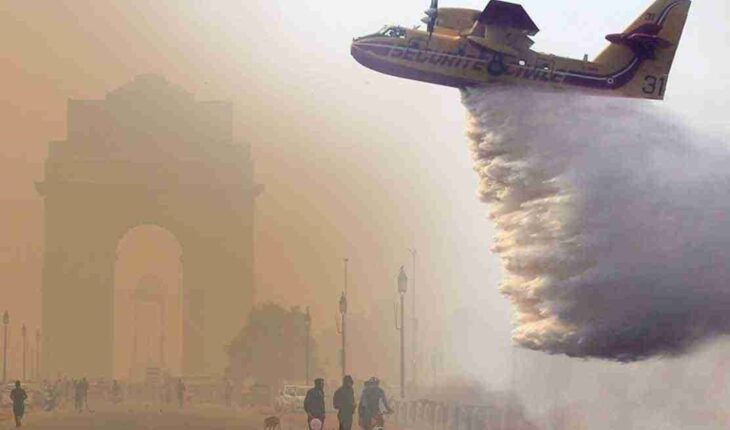
New Delhi (Rajeev Sharma): In a landmark environmental experiment, Delhi is expected to experience its first-ever bout of artificial rain on October 29, an initiative aimed at combating the city’s worsening air pollution in the aftermath of Diwali.
Chief Minister Rekha Gupta announced the development, stating that preparations are in full swing following a successful trial run over Burari, where scientists dispersed silver iodide and sodium chloride into existing clouds to test the technology.
The ambitious project is the result of a collaboration between the Delhi government, IIT Kanpur, the India Meteorological Department (IMD), and the Indian Institute of Tropical Meteorology (IITM), Pune. The operation has also received official clearance from the Directorate General of Civil Aviation (DGCA) to ensure airspace safety during the flights.
Scientific Method Behind the Rain
Artificial rainfall, or cloud seeding, involves the introduction of fine particles such as silver iodide or salt crystals into moisture-bearing clouds. These particles act as condensation points, helping water vapor coalesce into larger droplets that eventually fall as rain. However, for the method to work effectively, the target clouds must already contain adequate moisture—ideally more than 50 percent humidity.
Specially equipped aircraft fitted with flares will disperse these substances over northwest Delhi, where five trial sessions are scheduled. Scientists hope the rainfall will help wash away dust, smoke, and other airborne pollutants, providing short-term relief from the city’s toxic haze.
A Step Toward Cleaner Skies
Speaking to reporters, CM Rekha Gupta said, “Artificial rain is a bold experiment rooted in science. While it may not be a permanent fix, it could offer temporary relief to residents suffering from hazardous air quality levels.”
Environmental experts have welcomed the move, calling it a “creative intervention” to mitigate the health impact of the post-Diwali smog, which typically sends pollution levels soaring to “severe” on the Air Quality Index.
If successful, this pioneering project could set a precedent for similar weather-modification initiatives in other Indian cities struggling with poor air quality. For now, all eyes are on Delhi’s skies, as the capital prepares to make history with its first engineered rainfall—a blend of science, innovation, and hope for cleaner air.
