

PARIS (Rajeev Sharma): Rising living costs, housing pressures and frustration over economic opportunities have triggered large demonstrations across France, Belgium, Italy and Portugal, with clashes between protesters and police highlighting growing public discontent across Europe.
Saturday’s demonstrations unfolded independently in several cities, bringing together students, workers and other residents demanding action on financial pressures. While many rallies began peacefully, some descended into violence, with reports of looting, arson, vandalism and injuries to police officers.
France witnessed the largest mobilisation, with the Interior Ministry estimating that more than 550,000 people took part in demonstrations nationwide. The protests followed weeks of student-led unrest but escalated as groups of masked individuals targeted shops, public buildings and police vehicles.
French Prime Minister Sébastien Lecornu said around 1,200 people had been arrested and 150 police officers injured. Visiting officers deployed in central Paris, he described the scale of the violence as alarming and said the consequences could have been much worse.
Reports of looting emerged from Paris and several other cities, including Marseille, Nice, Nantes, Bordeaux, Lille, Toulouse and Strasbourg. Paris Mayor Emmanuel Grégoire said entire streets in the capital had suffered extensive damage.
In Limoges, a fire set during the unrest severely damaged the historic town hall, a building more than 140 years old. Municipal buildings in Marseille and Lille were also reportedly vandalised, while demonstrators set fire to Lyon’s tourist office.
President Emmanuel Macron condemned the destruction, warning that those responsible would face prosecution and punishment.
Belgium sees police action as demonstrations intensify
Brussels, which has already experienced weeks of student protests over university registration fees, saw further clashes as police used tear gas and water cannon to disperse crowds. Authorities accused some demonstrators of throwing objects at officers and starting fires.
Similar police tactics were deployed in Liège, east of the capital, as officials attempted to bring demonstrations under control. Authorities did not immediately provide attendance figures for the rallies.
The protests reflect wider concerns about the affordability of education and the growing financial burden on households, adding pressure on governments already facing demands for stronger economic support.
Housing and wages fuel anger in Portugal
In Lisbon, tens of thousands of people reportedly marched against expensive housing, low wages and the rising cost of everyday necessities.
Access to housing has become a particularly pressing issue in Portugal’s major cities. House prices have more than doubled since 2017, while rents for newly signed leases have climbed sharply, making it increasingly difficult for many residents to secure affordable accommodation.
The demonstrations have also exposed a divide between public expectations and the government’s response. Parliamentary Affairs Minister Carlos Abreu Amorim said on Friday that the government would not be swayed by pressure from street protests. Demonstrators, meanwhile, accused political leaders of failing to understand the difficulties facing ordinary people.
Violence erupts in Italian cities
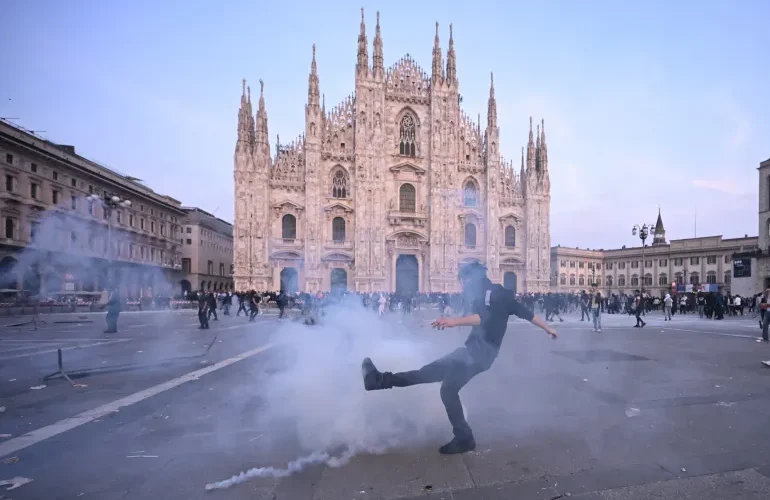
Milan experienced some of the most serious unrest outside France. A march initially organised against wars and rising living costs deteriorated when masked individuals threw stones and paving blocks at riot police, set barricades alight and damaged property in the city centre.
Police deployed tear gas and water cannon as crowds were dispersed from areas including Piazza del Duomo and a luxury shopping arcade. At least two officers were injured, while around 50 demonstrators were detained, according to Italian news agency LaPresse. Many of those detained were reportedly minors.
Prime Minister Giorgia Meloni condemned the violence, arguing that the right to protest did not justify setting fire to public spaces or destroying property.
Milan Mayor Giuseppe Sala acknowledged that protesters had legitimate concerns but said attacks on law enforcement and damage to the city could not be defended.
In Bologna, authorities also reported confrontations between demonstrators and police alongside peaceful rallies.
Wider European dissatisfaction comes into focus
Although demonstrations in Belgium, Italy and Portugal were smaller than those in France, analysts say the simultaneous unrest could indicate a broader wave of dissatisfaction spreading across the continent.
Alberto Alemanno, a professor of European Union law and policy at HEC Paris Business School, told Al Jazeera that France appeared to be at the centre of the current protest movement, while signs of similar mobilisation were emerging elsewhere.
He suggested that further demonstrations could take place in the coming days, with Greece, Germany and Austria among the countries where early signs of mobilisation were becoming apparent.
The protests do not represent one unified movement, Alemanno explained. Instead, they bring together different groups with overlapping concerns, including the cost of living, education funding and uncertainty about employment prospects after graduation.
The unrest also comes as Europe approaches a politically significant period, with several national elections scheduled over the next 12 months, including contests in Spain, France, Italy and Poland.
With economic pressures increasingly shaping public debate, the demonstrations could become a major issue for political parties and governments. The challenge for European leaders will be to address the underlying grievances while preventing further violence and restoring confidence among frustrated citizens.
