

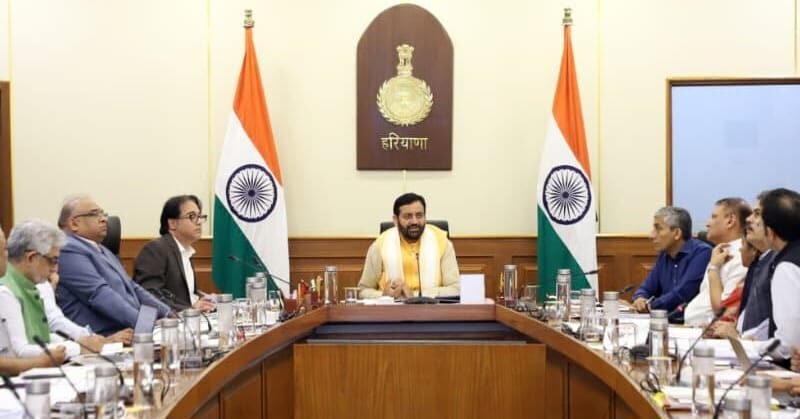
Chandigarh (Balwinder Singh): Haryana Chief Minister Nayab Singh Saini chaired a high-level review meeting on Tuesday, April 28, 2026, to evaluate the five-year implementation roadmaps of various state departments. Emphasizing that setting goals is insufficient without timely execution, the Chief Minister launched the “Vision to Action Artificial Intelligence” planning tool. Developed by the Swarna Jayanti Haryana Institute of Fiscal Management, this AI-driven platform is designed to provide uniform progress reports and ensure that year-by-year targets are met, aligning the state’s growth with the national “Viksit Bharat 2047” vision.
During the session, the Chief Minister underscored that the next five years are critical for transforming Haryana into a global innovation and industrial hub. He directed all departments to establish realistic yet ambitious timelines in coordination with NITI Aayog. To ensure grassroots impact, a robust monitoring mechanism will be developed, including monthly inspections of educational institutions by senior officials. The Chief Minister stressed that transparency and accountability through digital tools like the new AI planner would be the backbone of effective governance.
The education sector received significant focus, with the Chief Minister directing a push to increase the Gross Enrolment Ratio from 31% to 50% by 2047. Plans include establishing Modern Sanskriti Colleges in every district and launching four new polytechnics in Gurugram, Khedi Talwana, and Naraingarh. Additionally, universities performing at the level of premier institutes like IITs will be eligible for ₹5 crore grants to upgrade research and infrastructure. The government also aims to nearly double female participation in technical skills, rising from 17% to 33%.
On the industrial front, Commissioner and Secretary Dr. Amit Agarwal highlighted a roadmap to attract ₹5 lakh crore in investment and register over 5,000 new startups by 2030. To streamline operations, a new Single Window System 2.0 will be implemented by May 30, 2026, which is expected to reduce approval times by half. By focusing on cluster-based development and the PADMA scheme, Haryana intends to double its exports and establish itself as a sustainable, globally competitive industrial powerhouse.
