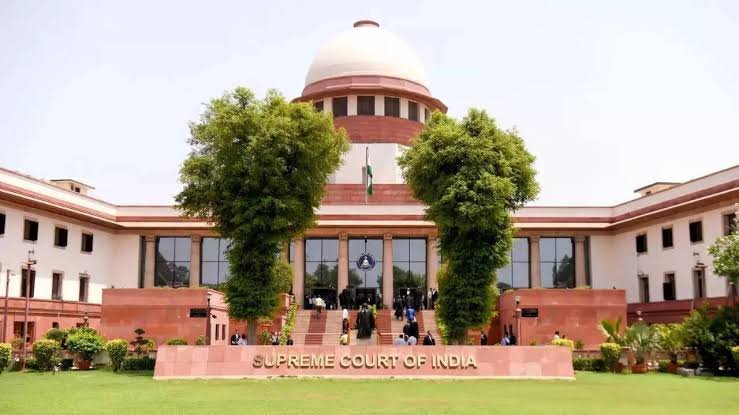
New Delhi (Gurpreet Singh): The Centre on Tuesday defended the traditional restriction on the entry of women aged 10–50 years into the Sabarimala Temple, asserting before the Supreme Court that matters of religious faith fall outside the scope of judicial review.
Presenting arguments before a nine-judge Constitution Bench led by Chief Justice of India Surya Kant, Solicitor General Tushar Mehta said courts should refrain from interpreting religious practices due to the inherent risks involved.
He argued that even if a practice appears unscientific, it is the legislature not the judiciary that should decide on reforms. Questioning the doctrine of “constitutional morality,” Mehta described it as a vague concept not explicitly defined in the Constitution.
Urging the Bench to reconsider its earlier ruling, Mehta stated that the 2018 judgment allowing women of all ages into the temple was “wrongly decided” and should be declared invalid. He emphasised the need to respect the traditions of religious denominations, citing examples from other places of worship where specific customs must be followed.
Highlighting the uniqueness of the Sabarimala shrine, Mehta said that while other temples dedicated to Lord Ayyappa allow women’s entry, the Sabarimala temple is a special case due to the deity’s status as a “Naishtika Brahmachari” (eternal celibate), which he argued cannot be subject to judicial scrutiny.
The Bench, also comprising Justice B.V. Nagarathna, Justice M.M. Sundresh, Justice Ahsanuddin Amanullah, Justice Aravind Kumar, Justice Augustine George Masih, Justice Prasanna B. Varale, Justice R. Mahadevan, and Justice Joymalya Bagchi, is hearing petitions seeking a review of the landmark Sabarimala Verdict 2018.
During the proceedings, Justice B.V. Nagarathna raised concerns over the interpretation of Article 17 in the 2018 verdict, questioning whether exclusion of women could be equated with “untouchability.” She remarked that such an interpretation may not be appropriate, noting the distinction between social discrimination and religious practices.
The court is also examining broader questions related to alleged discriminatory practices across religions to establish constitutional principles governing such matters.
The 2018 verdict, delivered by a five-judge Bench led by former CJI Dipak Misra, had struck down the traditional restriction, allowing women of all ages to enter the temple. However, Justice Indu Malhotra had dissented, supporting the continuation of the practice.
In 2019, while hearing review petitions, the Supreme Court expanded the scope of the case and referred key constitutional questions to a larger Bench, which is now being examined by the nine-judge Constitution Bench. The hearing remains ongoing and will continue on Wednesday.
Centre Defends Sabarimala Tradition in Supreme Court, Calls 2018 Verdict ‘Wrong Law’
 0 Comments