

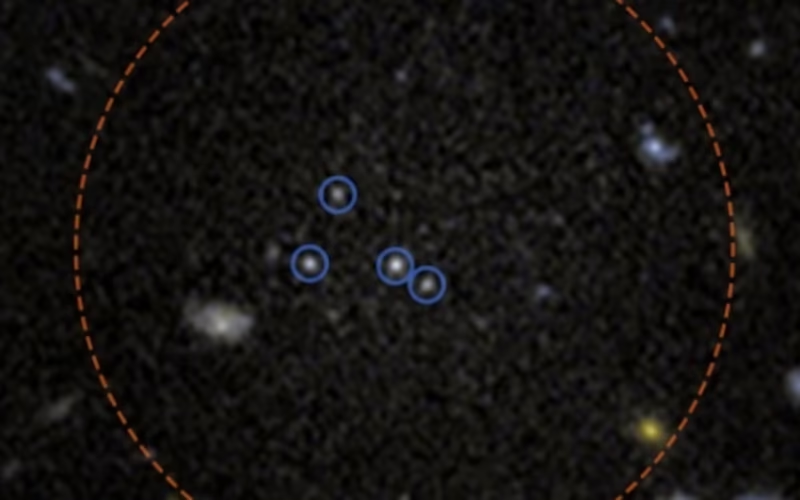
Toronto (Rajeev Sharma)— A Canadian-led team of astronomers has identified a nearly invisible “dark galaxy,” nicknamed a “ghost galaxy,” located roughly 250 million light-years from Earth. The discovery of CDG-2 (Candidate Dark Galaxy-2) highlights how much of the universe remains a mystery, as the galaxy is thought to be composed of 99.9% dark matter.
“Yeah, it’s pretty much invisible,” said David Li, a post-doctoral fellow at the University of Toronto and lead researcher on the project. Li, a specialist in the burgeoning field of astrostatistics, used advanced statistical tools to identify patterns in space that traditional observation might miss. The discovery has garnered global attention from NASA and the European Space Agency (ESA).
How to Find the Invisible
Because dark galaxies emit almost no light, the team had to use an indirect method of detection. They focused their search on globular clusters—tightly packed groups of ancient stars. While scanning a seemingly empty patch of space, they noticed four globular clusters orbiting a common centre. The team realized a massive, invisible gravitational force must be holding them together.
To confirm the presence of CDG-2, the researchers combined data from three of the world’s most powerful telescopes:
- NASA’s Hubble Space Telescope
- ESA’s Euclid Space Telescope
- Subaru Telescope (Hawaii)
They eventually detected a “very faint smudge” and a diffuse structure around the clusters. CDG-2 possesses the brightness of only about 5 million stars, a minuscule fraction compared to the 100 to 400 billion stars found in our Milky Way.
A Galactic Skeleton
Researchers believe CDG-2 wasn’t always this dark. They theorize that ancient encounters with larger neighbouring galaxies “stripped” CDG-2 of the gas and material needed to form new stars. “Only a skeleton of what it once was remains,” Li explained, justifying the “ghost” moniker.
The discovery is part of a series of recent breakthroughs by Canadian institutions in 2026:
- University of Waterloo: Observed the most distant “jellyfish galaxy,” featuring long tentacles of trailing gas.
- Dalhousie & UBC: Found a cluster of galaxies with scorching hot gas existing just 1.4 billion years after the Big Bang, defying current cosmological models.
The Dark Matter Mystery
Dark matter is often called the “invisible glue” of the universe. Though it has never been directly observed since it was first proposed in 1933, it is believed to make up 80% of all matter in the universe. Scientists can only detect it by observing its gravitational influence on visible objects, like the four globular clusters orbiting CDG-2.
Li hopes that identifying thousands more of these dark galaxies in the future will finally allow astronomers to unlock the true nature of dark matter and how it shapes the cosmos.
