

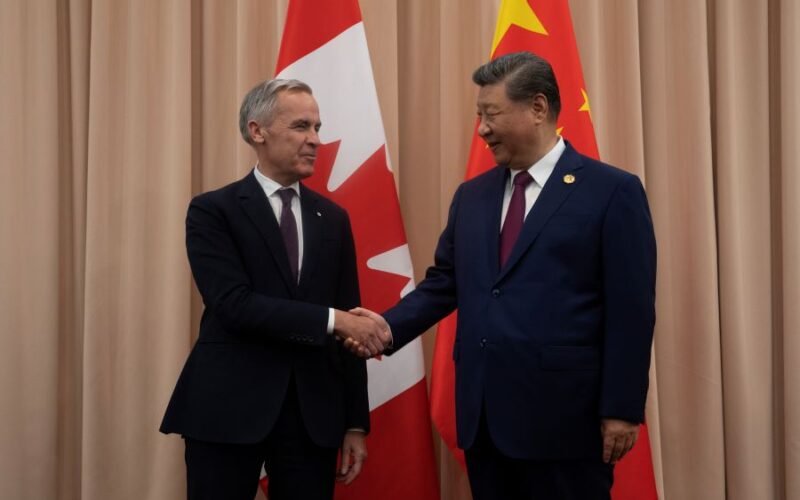
Ottawa (Rajeev Sharma): Canada has finalised a fresh trade understanding with China that is expected to unlock export opportunities worth over USD 7 billion, Prime Minister Mark Carney announced on Saturday, signalling a recalibration of Ottawa’s global trade strategy.
The Prime Minister said the agreement would help Canadian companies expand their footprint in overseas markets while supporting jobs at home. In a message shared on social media, Carney described the deal as a step toward strengthening Canada’s economic resilience at a time of global uncertainty.
An official statement from the Prime Minister’s Office said the government is moving quickly to reduce overdependence on a limited number of trade partners. It added that China’s economic scale and consumer demand make it a critical market as Canada seeks to attract investment and stabilise supply chains.
Diplomatic Reset in Beijing
The agreement follows Carney’s high-profile visit to Beijing earlier this week, marking the first time in nearly a decade that a Canadian prime minister has travelled to China. During the visit, Carney held talks with President Xi Jinping, Premier Li Qiang and senior parliamentary leader Zhao Leji.
Following these discussions, leaders from both countries released a joint statement outlining a roadmap for renewed cooperation, focusing on trade, investment and long-term economic engagement.
Key Trade Concessions
Under the arrangement, Canada has agreed to significantly reduce duties on Chinese-made electric vehicles, which previously faced a 100 per cent tariff. In return, Beijing will ease restrictions on Canadian agricultural exports, particularly canola, one of Canada’s most important farm commodities.
According to media reports, exports of Chinese electric vehicles to Canada will be capped at just under 50,000 units annually at the outset, with gradual increases planned over a five-year period. China, meanwhile, will slash tariffs on Canadian canola seeds from punitive levels of over 80 per cent to around 15 per cent.
Shifting Trade Dynamics
Carney suggested that recent dealings with Beijing have produced clearer and more predictable outcomes compared to Canada’s trade engagement with the United States. Canada currently faces multiple trade barriers south of the border, including high levies on metals, automobiles and a broad range of goods.
The announcement comes amid ongoing trade tensions between the US and China, which have seen both sides threaten sweeping tariff hikes in recent months. While some duties were temporarily suspended following talks between US President Donald Trump and Chinese leadership, uncertainty remains in global trade flows.
Canada’s new trade framework with China reflects Ottawa’s effort to adapt to a changing economic landscape by diversifying partners and reducing exposure to escalating geopolitical disputes.
