

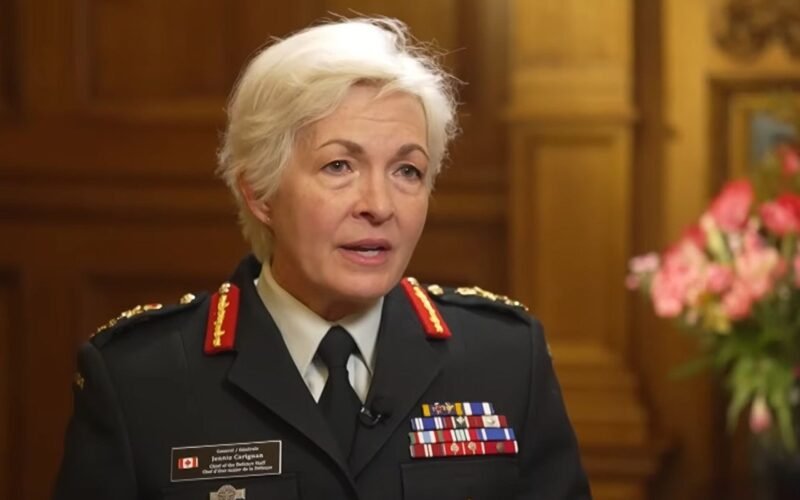
Ottawa (Rajeev Sharma): Canada’s top military commander, Jennie Carignan, has cautioned that the country must brace for the possibility of large-scale conventional conflicts, signalling a significant shift in defence priorities amid a rapidly evolving global security landscape.
Speaking about the changing nature of threats, General Carignan said the world has entered a more volatile phase, requiring Canada to rethink its military capabilities and preparedness. She stressed that the armed forces must adapt to face more traditional, high-intensity conflicts, a departure from the counterinsurgency operations that dominated recent decades.
To address these challenges, Canada is planning a major expansion of its defence structure. The strategy includes increasing the number of full-time troops, strengthening reserve forces, and creating a “strategic reserve” of up to 300,000 trained civilians who could be mobilised during emergencies.
Security concerns are being shaped by the growing capabilities of nations such as Russia and North Korea, particularly in long-range missile technology that could potentially threaten North America. Additionally, rising geopolitical competition in the Arctic region—where global powers are vying for influence—has emerged as a key area of focus for Canadian defence planners.
In response, Prime Minister Mark Carney’s government is exploring deeper collaboration with international partners. One option under consideration is joining the Joint Expeditionary Force (JEF), a UK-led coalition designed for rapid military response across regions such as the Baltic Sea, North Atlantic, and Arctic.
General Carignan recently held discussions in London with members of the alliance, which includes several Nordic and Baltic nations along with the Netherlands. She described the engagement as encouraging, highlighting opportunities for intelligence-sharing, joint exercises, and coordinated operations.
Unlike larger alliances such as NATO, the JEF allows member countries to act more swiftly without requiring unanimous approval, making it a flexible tool for addressing emerging threats, including attacks on critical infrastructure like undersea cables and energy pipelines.
Reflecting on Canada’s evolving defence posture, Carignan noted that earlier reductions in military spending had delayed such initiatives, but current realities demand renewed investment and cooperation.
Appointed as Canada’s Chief of the Defence Staff in 2024, Carignan also made history as the first woman to lead the country’s armed forces. With decades of service, including deployments in Afghanistan and Iraq, she emphasised that institutional reforms over the years have enabled greater inclusion and leadership opportunities within the military.
Her remarks underline a broader shift as Canada positions itself to respond to an increasingly uncertain global environment, where preparedness and alliances are becoming central to national security.
