

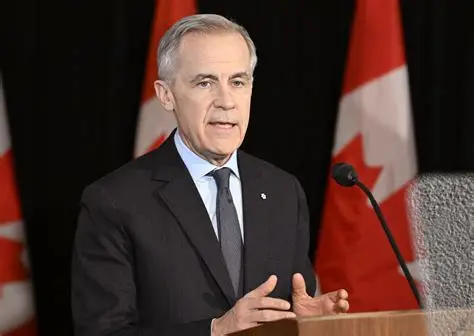
Ottawa (Rajeev Sharma): Canadian Prime Minister Mark Carney on Sunday said that Canada has no intention of pursuing a free trade agreement with China, responding to US President Donald Trump’s warning of imposing 100 per cent tariffs on Canadian goods if Ottawa moved ahead with a trade deal with Beijing.
Carney clarified that Canada’s recent engagement with China does not amount to a free trade agreement, but instead focuses on resolving limited tariff-related issues that arose over the past two years. He said Canada has no intention of entering into free trade agreements with China or any other non-market economy.
He further explained that under the United States–Mexico–Canada Agreement, there are commitments requiring member countries to notify partners before pursuing free trade agreements with non-market economies. According to Carney, Canada’s recent actions were aimed only at rectifying trade disruptions that had developed recently.
Trump, however, disputed Carney’s position, claiming on social media that China was taking over Canada and warning that Ottawa would not be allowed to become a transit point for Chinese goods entering the United States.
In 2024, Canada mirrored US trade measures by imposing a 100 per cent tariff on Chinese electric vehicles and 25 per cent tariffs on steel and aluminium. China responded by levying 100 per cent import taxes on Canadian canola oil and meal, along with 25 per cent tariffs on pork and seafood.
Earlier this month, during a visit to China, Carney announced a reduction in Canada’s 100 per cent tariff on Chinese electric vehicles in exchange for lower Chinese tariffs on certain Canadian products. Under the revised arrangement, Canada will allow an initial annual cap of 49,000 Chinese electric vehicles at a tariff rate of 6.1 per cent, which will increase to around 70,000 vehicles over five years. Carney said these imports would account for only a small share of Canada’s annual vehicle sales and added that China is expected to invest in Canada’s auto industry within three years.
Trump continued to criticise the move, calling it one of the worst trade decisions and warning that Canada’s auto industry cannot survive without access to the US market. US Treasury Secretary Scott Bessent also said Washington would not allow Canada to become an entry point for low-cost Chinese goods into the United States, especially as the USMCA is expected to be renegotiated this summer.
The remarks come amid rising tensions between Carney and Trump, including disagreements over global trade policies, strategic alliances, and Trump’s comments regarding Canadian sovereignty.
