

Calgary (Rajeev Sharma) — City officials say Calgary could begin easing water-use restrictions early next week as repairs to a critical water main move closer to completion, though residents are being warned that conservation efforts will return in the spring.
Michael Thompson, Calgary’s general manager of infrastructure services, said a damaged portion of the Bearspaw South Feeder Main has been replaced and crews are now refilling the line. The process involves pumping roughly 22 million litres of water — enough to fill nine Olympic-sized swimming pools — back into the system before testing water quality.
“About seven kilometres of pipe had to be drained, and refilling it is a careful process,” Thompson said during a news conference Saturday. “We’re optimistic that we can start relaxing restrictions early next week.”
However, officials cautioned that the situation remains fragile, with the possibility of another failure still present.
“This is the most critical stage of the repair,” Mayor Jeromy Farkas said. “We’re asking people to keep conserving water for a few more days. We’re not fully in the clear yet.”
City officials also confirmed that further reinforcement work on the feeder main will be required in the spring, when weather conditions allow for repairs that cannot be completed during winter. Additional water-use restrictions are expected at that time, though specific details have not yet been released.
Thompson explained that delaying some repairs until spring will allow the city to rely on snowmelt to replenish reservoirs during the work.
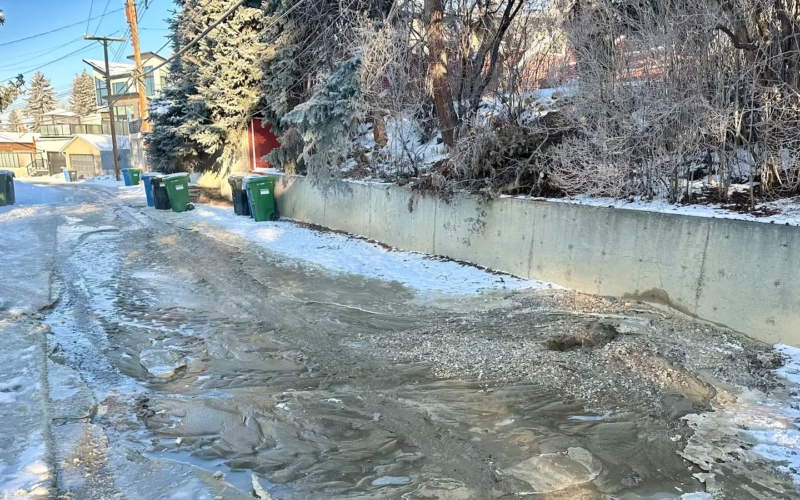
Calgary has been under strict water conservation measures since Dec. 30, when the Bearspaw South Feeder Main — which supplies about 60 per cent of the city’s treated water — ruptured for the second time in roughly 18 months. A similar failure in the summer of 2024 led to months of restrictions and a declared state of emergency.
Despite repeated calls to conserve, city data shows daily water use continues to exceed the city’s target of 485 million litres. Sue Henry, chief of the Calgary Emergency Management Agency, said residents used 504 million litres of water on Friday alone.
“We’re asking everyone to reduce their daily use by 25 to 30 litres per person,” Henry said. “Simple actions like shorter showers, flushing less often and running appliances only when full can make a real difference.”
As the repaired pipe is refilled, residents may notice temporary changes such as reduced water pressure, cloudy water or a stronger chlorine smell. Thompson said these effects are normal and should resolve within a few days, stressing that the water remains safe to drink.
Acknowledging public frustration, Farkas said the city is working urgently to stabilize the system.
“We’re moving as fast as possible to restore this pipe and to create a long-term solution that prevents this from happening again,” he said.
