

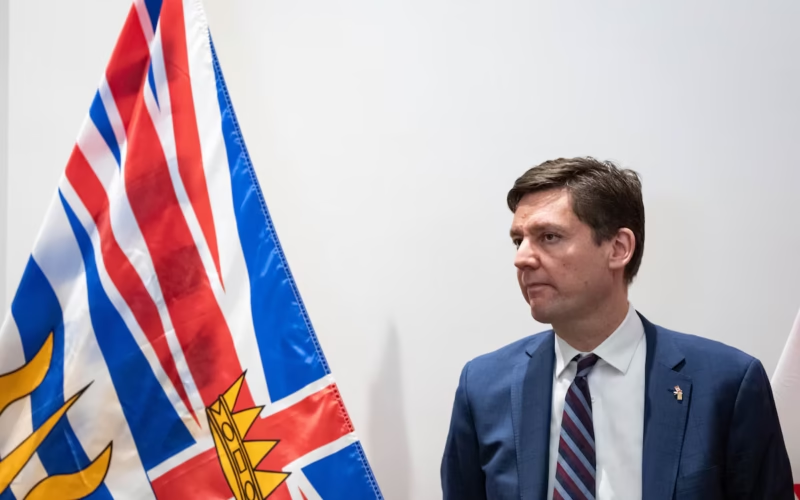
British Columbia (Rajeev Sharma): British Columbia Premier David Eby departed for India on Friday, launching a trade-focused visit that underscores a changing approach in Canadian economic strategy — one that places commercial opportunity ahead of unresolved diplomatic tensions.
The trip is deliberately low-profile. No business delegations or ceremonial events are scheduled, and the premier is accompanied only by Jobs and Economic Growth Minister Ravi Kahlon and a small support team. Despite its modest format, the mission carries significant weight as Canada and its provinces seek to reduce reliance on the United States amid escalating trade barriers and political uncertainty.
The timing is notable. Canada’s relationship with India remains fragile following a serious diplomatic clash in 2023, when Ottawa accused Indian authorities of involvement in the killing of Sikh activist Hardeep Singh Nijjar in Surrey, British Columbia. India rejected the claim, and bilateral ties cooled sharply. While some diplomatic positions have since been restored, the relationship has yet to fully normalize.
Still, economic realities are driving engagement. Like Prime Minister Mark Carney, who is preparing for a visit to China later this month to reopen trade channels, provincial leaders are taking a pragmatic stance. With U.S. tariffs squeezing key Canadian industries, diversification has become an urgent priority.
Premier Eby acknowledged that not all British Columbians support expanding trade with India while questions around Nijjar’s death remain unresolved. However, he stressed that matters of diplomacy and criminal accountability fall under federal jurisdiction and the court system, not provincial trade offices.
“Our responsibility is to protect jobs and economic opportunity here at home,” Eby said ahead of his departure. “When relationships begin to warm and opportunities emerge, British Columbia needs to be ready to act — especially for industries facing the greatest pressure from U.S. tariffs.”
Throughout the diplomatic fallout, B.C. quietly kept its trade presence in India intact, maintaining offices in Chandigarh, New Delhi, Mumbai, and Bengaluru. Staffing levels remained unchanged, and Eby plans to visit each location during his trip.
While India currently represents a small share of B.C.’s export portfolio, its importance is growing. In 2024, only about two per cent of the province’s goods exports went to India, compared with nearly half to the United States. However, recent trends show U.S. demand weakening due to rising tariffs, while trade with India continues to expand.
Since 2014, B.C.’s merchandise exports to India have more than doubled, reaching approximately $1.3 billion, driven largely by energy-related products. Services exports are also climbing rapidly, making India B.C.’s fastest-growing services market in Asia.
Eby emphasized that the purpose of the visit is not to finalize contracts but to strengthen long-term connections. With India on track to become the world’s third-largest economy, he said, early engagement could yield lasting benefits.
Industry groups are watching closely. Kim Haakstad, president of the BC Council of Forest Industries, said the forestry sector sees India as a future opportunity rather than an immediate replacement for U.S. demand. Rising softwood lumber duties south of the border — now exceeding 45 per cent for many producers — have made alternative markets increasingly attractive.
Although shipping lumber to India involves a lengthy sea journey, Haakstad noted that logistical challenges are not insurmountable. “Producers have already learned how to move product efficiently to distant markets like the U.K.,” she said. “Once that infrastructure exists, India becomes feasible.”
Minister Kahlon said the province will use the trip to promote a range of sectors, including clean energy, critical minerals, life sciences, and agricultural technology. Diversification, he added, is essential to meeting B.C.’s long-term export goals.
“Our aim is to reduce dependence on any single market, expand global reach, and create resilient growth,” Kahlon said. “India plays a key role in that future.”
As global trade patterns shift and political alliances evolve, British Columbia’s outreach to India signals a broader recalibration — one where economic survival and growth are increasingly guiding international engagement.
