

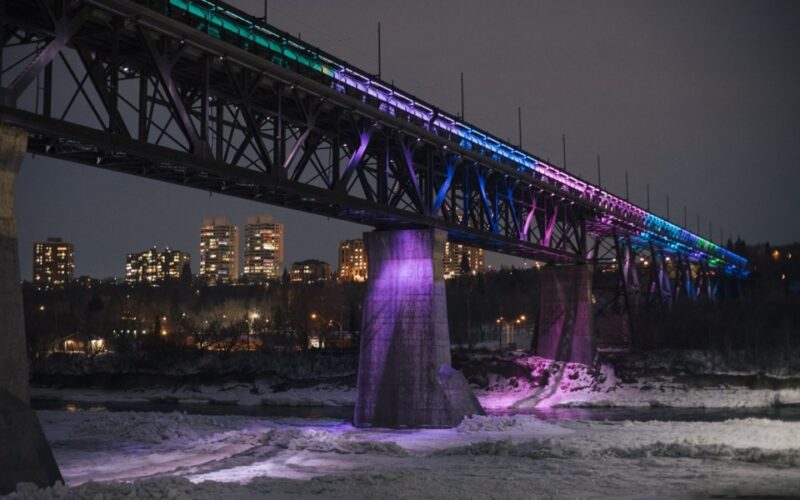
Edmonton (Rajeev Sharma): Edmonton’s iconic High Level Bridge continues to face challenges from oversized trucks, prompting Alberta’s government to explore new measures to prevent collisions. Transportation Minister Devin Dreeshen revealed plans for stricter policies, including a “naughty list” for truckers, aimed at reducing incidents near the 112-year-old landmark.
The double-decker steel bridge, which spans over 750 metres across the North Saskatchewan River, has seen five direct hits and ten near-misses by large trucks this year alone. Despite bright warning signs indicating the bridge’s limited clearance—10.6 metres on the lower deck—truck drivers frequently attempt to cross, causing traffic congestion and damage. Police reports show that in the past six years, the bridge has been struck 21 times, with an additional 63 near-misses.
Originally built by the Canadian Pacific Railway, the High Level Bridge has a rich history, having supported horses, streetcars, trains, and early automobiles. It was designated a local historic resource in 1995, which restricts major structural alterations but requires ongoing maintenance. The city has previously added safety measures such as emergency phones, higher barriers, and programmable lights, while turning off a decorative waterfall that ran for decades.
Minister Dreeshen indicated that the new provincial approach will track truckers who damage infrastructure. Drivers will need to provide a record of any previous bridge incidents when switching employers. “If you hit a bridge and change companies, that history will follow you,” Dreeshen said. “You won’t be able to hide as much as in the past.”
Currently, fines for bridge collisions can reach $10,000, but a provincial review of relevant legislation next year could increase penalties and provide authorities with the power to suspend or revoke licences. The ministry is also considering educational programs for trucking companies as part of broader safety measures.
While Dreeshen’s initiative aims to prevent damage and protect motorists, some experts are skeptical. Jurgen Henn, who documents bridge collisions in North Carolina, notes that even severe penalties may not stop accidents, as many drivers are unaware of clearance limits or make critical errors.
As Edmonton continues to balance historic preservation with modern transportation demands, authorities hope that combining stricter enforcement with driver accountability will reduce risks to both the High Level Bridge and the surrounding community.
