

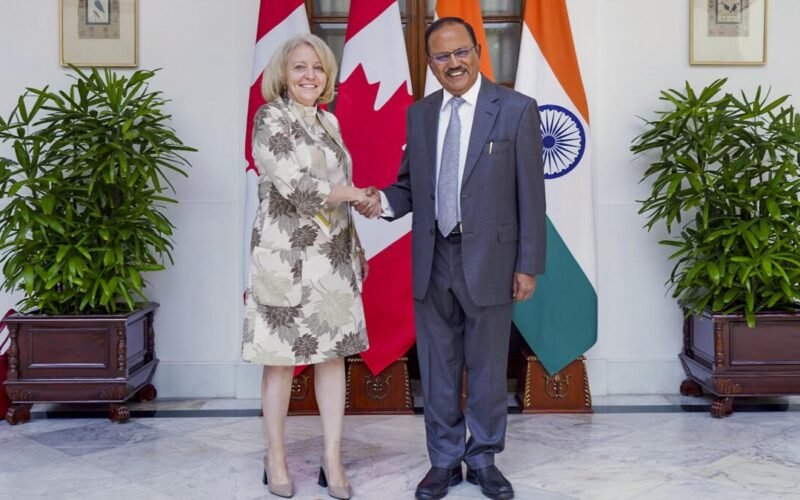
Ottawa (Rajeev Sharma): India and Canada appear to be cautiously moving toward repairing their fractured relationship, with National Security Adviser Ajit Doval’s recent visit to Ottawa emerging as a key diplomatic signal. The two-day visit, held from February 6 to 7, marked one of the most substantive security-level engagements between the two countries since ties deteriorated sharply in 2023.
Doval held discussions with Canada’s Deputy Clerk and National Security and Intelligence Adviser to the Prime Minister, Nathalie Drouin, and Public Safety Minister Gary Anandasangaree. While both governments described the meetings as part of routine bilateral security dialogue, officials and analysts view the engagement as a deliberate attempt to stabilise relations after a prolonged period of tension.
Significantly, the visit is being interpreted as a message that the current Canadian leadership under Prime Minister Mark Carney does not endorse extremist activities, including those linked to Khalistani networks—an issue that has been a major point of contention between New Delhi and Ottawa.
Focus on practical cooperation
According to India’s official statement, both sides acknowledged progress in ongoing efforts aimed at safeguarding national and public security. They agreed to a shared roadmap to guide cooperation in national security and law enforcement, stressing the need for tangible, outcome-driven collaboration.
Canada’s readout struck a similar tone, emphasising concrete steps rather than political posturing. Among the key outcomes was a decision to post security and law-enforcement liaison officers in each other’s countries. Officials said this mechanism would improve coordination and allow faster exchange of intelligence on shared concerns.
These include transnational organised crime, narcotics trafficking—particularly the flow of fentanyl precursors—and other cross-border threats that have grown in scale and complexity. Discussions also extended to cybersecurity cooperation, information-sharing on digital threats, fraud prevention and immigration enforcement, with both sides noting that collaboration would respect domestic laws and international commitments.
Context of strained ties
The renewed engagement comes after years of diplomatic strain, especially during the tenure of former Canadian prime minister Justin Trudeau. Relations hit a low point in 2023 after Trudeau alleged a possible Indian connection to the killing of Khalistani separatist Hardeep Singh Nijjar in Canada—an accusation New Delhi firmly rejected as baseless.
That episode triggered sharp exchanges, reduced diplomatic engagement and a significant erosion of trust. Against this backdrop, the resumption of structured security dialogue is being seen as an effort by both governments to move beyond confrontation and restore a degree of predictability to the relationship.
Looking ahead
Doval’s visit is also being viewed as laying the groundwork for a potential visit by Prime Minister Mark Carney to India next month. If it materialises, it would mark the first prime ministerial-level interaction since bilateral ties plunged to one of their lowest points in decades.
Rather than dramatic reconciliation, both sides appear focused on rebuilding confidence incrementally. Analysts note that cooperation in technical and enforcement areas—such as policing, cyber policy and intelligence-sharing—can help create momentum for broader political engagement over time.
While many issues remain unresolved, the Ottawa meetings suggest a willingness on both sides to re-engage pragmatically. For now, India and Canada seem to be steering their relationship away from confrontation and toward cautious normalisation, one measured step at a time.
